
Mushroom Plant Protein: Exact Extract Amounts Per Serving
Mushroom Plant Protein: Exact Extract Amounts Per Serving
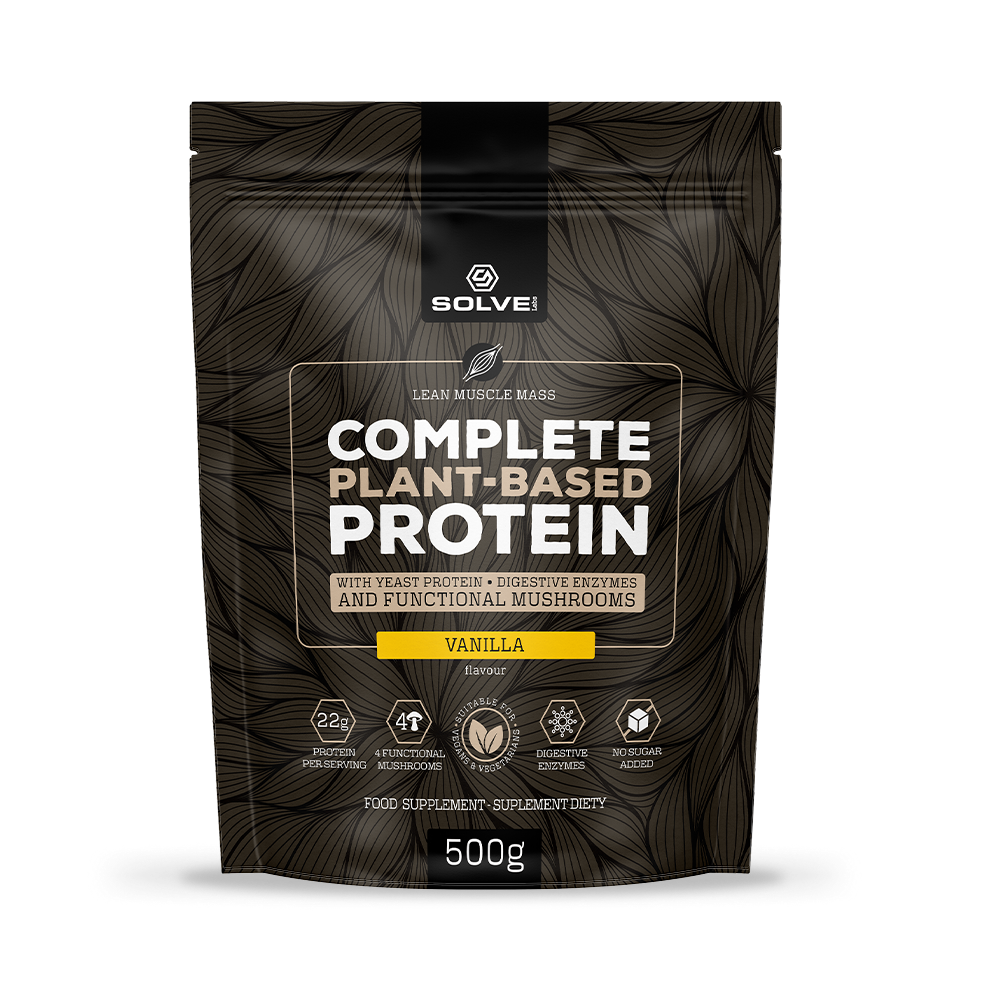
- Each 35 g serving delivers 250 mg each of Lion's Mane, Chaga, Reishi, and Cordyceps as 10:1 fruiting-body extracts, 1,000 mg mushroom extract total, plus 22 g of four-source plant protein.
- 250 mg per mushroom is a supportive, maintenance-level dose, below the 500-3,000 mg/day ranges used in most human efficacy trials for nootropic, ergogenic, or immune endpoints.
- The 150 mg DigeZyme® multi-enzyme complex has a clinical basis for reducing post-exercise muscle soreness and may ease digestion of plant protein.
- No published trial exists on this specific mushroom-protein blend; efficacy is inferred from research on the individual mushrooms.
- At a glance
- How much of each mushroom extract is included per serving?
- What does "10:1 fruiting-body extract" actually mean?
- Are the dosages actually therapeutic, or token amounts?
- What are the 4 plant protein sources in the blend?
- Will DigeZyme® prevent the bloating I get from pea protein?
- Health benefits, and how strong the evidence is
- Is it complete, and what's the full macronutrient picture?
- Meal replacement or strictly post-workout?
- Allergen suitability, standardisation, and testing
- How long until it works, and when to be cautious
- Related guides
Solve Labs' Mushroom Plant-Based Protein delivers 250 mg each of four functional mushroom extracts, Lion's Mane, Chaga, Reishi, and Cordyceps, for a total of 1,000 mg of mushroom extract per 35 g serving, all labelled as 10:1 concentrated fruiting-body extracts, alongside roughly 22 g of four-source plant protein [4][6][8]. Each mushroom carries its own quantified callout, no proprietary blend hides the split. That transparency lets us do the math instead of trusting a marketing line: at 250 mg each, these are supportive adaptogenic doses, generally below the therapeutic ranges used in most human trials on the individual mushrooms [4].
Provenance: this is a product-information reference, last verified against the current Solve Labs Supplement Facts panel. Every dosage figure is drawn from the labelled amounts [6][8]. Every efficacy claim is graded against published human research on the individual mushrooms, not on this specific blend, for which no clinical trial exists [4][7]. Evidence grade is stated inline for each claim.
At a glance
| Component | Amount per 35 g serving | Form | What it's for | Evidence at this dose |
|---|---|---|---|---|
| Lion's Mane (Hericium erinaceus) | 250 mg | 10:1 fruiting-body extract | Cognitive recovery, NGF support | Weak, trials use 500-1,000 mg/day [4] |
| Chaga (Inonotus obliquus) | 250 mg | 10:1 fruiting-body extract | Antioxidant / immune support | Maintenance-level, trials use 500-1,500 mg/day [4] |
| Reishi (Ganoderma lucidum) | 250 mg | 10:1 fruiting-body extract | Adaptogen, cortisol/immune modulation | Low, immune trials use ~1,500 mg/day [4] |
| Cordyceps (Cordyceps sinensis) | 250 mg | 10:1 fruiting-body extract | ATP production, exercise performance | Sub-ergogenic, trials use 1,000-3,000 mg/day [4] |
| Plant protein blend | 22-22.4 g | Pea, yeast, rice, pumpkin | Muscle protein synthesis, recovery | Strong (complete amino profile) [1][4][6] |
| DigeZyme® enzyme complex | 150 mg | Multi-enzyme (α-amylase, protease, cellulase, lactase, lipase) | Digestion, soreness reduction | Moderate, clinical study on soreness [4][7] |
How much of each mushroom extract is included per serving?
The label is explicit: 250 mg of Lion's Mane, 250 mg of Chaga, 250 mg of Reishi, and 250 mg of Cordyceps per 35 g serving, each as a 10:1 fruiting-body extract [6][8]. Add them and you get exactly 1,000 mg of total mushroom extract [6]. No proprietary blend line obscures the ratio, and that single design choice is what lets you benchmark each dose against the research instead of guessing.
Compare that to competitors. OM Mushroom's blend lists 2,000 mg per serving [2][6], double the mushroom fraction here. Solve Labs sits at half that. State it plainly: the mushroom fraction is an adjunct to a protein product, not a standalone mushroom supplement.
What does "10:1 fruiting-body extract" actually mean?
A 10:1 ratio means 10 parts of raw mushroom were concentrated into 1 part of finished extract [6][8]. So 250 mg of a 10:1 extract represents the bioactive yield of roughly 2,500 mg of raw fruiting body. Concentration is the point, it raises the density of the compounds that matter: beta-glucans (immune-active polysaccharides), triterpenes and terpenoids, and, in Cordyceps, cordycepin [6][8].
Two limits before you read too much into the ratio. "10:1" describes concentration, not potency, it does not guarantee a specific percentage of beta-glucans, and the label does not appear to state a standardised beta-glucan figure [8]. And no third-party potency verification is published for this product [8]. A concentration ratio is a manufacturing claim. A standardised beta-glucan percentage plus a certificate of analysis is a verification claim, different levels of proof, and this label carries the first, not the second.
Are the dosages actually therapeutic, or token amounts?
Fair question, here is the calibrated answer. 250 mg per mushroom is a supportive dose, generally below the ranges that produced measurable effects in human trials on each mushroom individually [4]. The worked comparison:
| Mushroom | Dose here | Dose in human trials | Verdict at 250 mg |
|---|---|---|---|
| Lion's Mane | 250 mg | 500-1,000 mg/day (8:1-10:1) for cognition [4] | Possibly suboptimal for nootropic effect |
| Cordyceps | 250 mg | 1,000-3,000 mg/day for exercise/ATP [4] | Likely insufficient for ergogenic benefit |
| Reishi | 250 mg | ~1,500 mg/day for immune modulation [4] | Low-dose adaptogenic |
| Chaga | 250 mg | 500-1,500 mg/day for antioxidant/immune [4] | Maintenance-level |
The 10:1 concentration partly closes the gap, 250 mg of extract is not 250 mg of dried mushroom. But most of the trials above also used concentrated extracts at those higher milligram figures [4], so the gap doesn't fully close. The best interpretation: Solve Labs uses these mushrooms as an adaptogenic, recovery-supporting adjunct to a protein product. Mechanism plausible, standalone nootropic or ergogenic claims weakly supported at 250 mg [4]. If your primary goal is a Lion's Mane nootropic effect, a dedicated 500-1,000 mg product is the evidence-aligned choice.
What are the 4 plant protein sources in the blend?
The protein is the headline, 22-22.4 g per serving from four sources: pea, yeast, rice, and pumpkin [1][4][6]. Run the ratio and the product declares itself: the 1,000 mg mushroom fraction is about 4.5% of the serving by weight against the protein [4][6]. This is a protein powder with a functional-mushroom top-up, not a mushroom capsule with protein filler.
Combining plant proteins is deliberate engineering. Pea protein is high in lysine but comparatively lower in methionine. Rice protein is the reverse. Blend them with yeast and pumpkin protein and you cover the shortfall, the standard strategy for a complete amino acid profile, all nine essential amino acids in adequate ratios, to support muscle protein synthesis [1][4][6]. This mechanism is well established and the evidence is strong.
Will DigeZyme® prevent the bloating I get from pea protein?
The product includes 150 mg of DigeZyme®, a multi-enzyme complex containing α-amylase, protease, cellulase, lactase, and lipase [4][7]. The mechanism is direct, protease breaks down protein and cellulase breaks down plant fibre, the two components most often blamed for legume-related bloating. So there is a plausible route to gentler digestion.
The strongest published support for DigeZyme® is about recovery, not bloating, a clinical study found it reduced post-exercise muscle soreness after eccentric exercise [4][7]. That maps cleanly onto a post-workout protein. On bloating, the mechanism is reasonable but I won't overpromise, enzyme complexes ease digestion for many people, individual response varies. Set the honest expectation: mild GI effects (bloating, soft stools, transient nausea) are commonly reported in the first 1-2 weeks of any new mushroom or high-fibre protein product, and typically settle as the gut adapts.
Health benefits, and how strong the evidence is
Muscle recovery and protein synthesis (strong evidence)
The 22 g complete-protein dose delivers the essential amino acids, including leucine, required to trigger muscle protein synthesis [1][4][6]. This is the product's best-evidenced benefit and its primary function.
Reduced post-exercise soreness (moderate evidence)
The 150 mg DigeZyme® has a clinical study behind its soreness-reducing effect after eccentric exercise [4][7]. A specific, cited finding, not a vague "recovery" claim.
Cognitive recovery via Lion's Mane (weak at this dose)
Lion's Mane may support nerve growth factor (NGF) synthesis, a mechanism linked to neuronal maintenance and neuromuscular signalling. Human cognition trials used 500-1,000 mg/day [4], double to quadruple the 250 mg here. Mechanism plausible, dose likely subtherapeutic for a standalone nootropic claim.
Exercise performance via Cordyceps (weak at this dose)
Cordyceps supports ATP production and oxygen utilisation, with ergogenic effects reported at 1,000-3,000 mg/day [4]. At 250 mg, an isolated performance benefit is weakly supported.
Immune and antioxidant support (low-dose adaptogenic)
Reishi's immune-modulating effects appear around 1,500 mg/day [4]. Chaga's antioxidant and immune support run 500-1,500 mg/day, via mechanisms including superoxide dismutase (SOD) activity [4]. At 250 mg each these are maintenance-level, supportive amounts, reasonable in a daily-use product, not a therapeutic immune protocol.
Is it complete, and what's the full macronutrient picture?
Yes, the four-source blend is formulated to deliver all essential amino acids [1][4][6]. For exact per-serving carbohydrate, fat, and calorie figures, defer to the current Supplement Facts panel, since formulas can change. The fixed, verifiable figures are the 22-22.4 g protein, 1,000 mg total mushroom extract, and 150 mg DigeZyme® [1][4][6][7].
Meal replacement or strictly post-workout?
At 22 g protein plus digestive enzymes and adaptogenic mushrooms, it works best as a post-workout recovery shake, which is exactly where the DigeZyme® soreness data and the amino profile point [4][7]. It can supplement a meal. A full meal replacement generally needs added micronutrients, fibre, and fat targets, confirm those against the label rather than assume them.
Allergen suitability, standardisation, and testing
The protein sources are pea, yeast, rice, and pumpkin, no soy, no tree nuts. Anyone with an allergy should still verify the manufacturing facility's cross-contamination statement on the current label before relying on that [6]. On standardisation: the extracts are labelled 10:1, but a specific beta-glucan percentage does not appear to be stated, and no third-party potency verification is published [8]. If independent COA verification is a dealbreaker, treat it as an open item to confirm with the manufacturer.
How long until it works, and when to be cautious
Set expectations by mechanism. Protein-driven recovery is essentially immediate, the amino acids are available within hours of intake. Adaptogenic and cognitive effects, where present, accrue over weeks of consistent use, not days, "nothing in the first week" is normal for the mushroom fraction. And because the mushroom doses are supportive rather than therapeutic, calibrate accordingly [4].
Caution is advised for a few groups. Reishi and other beta-glucan-rich mushrooms may interact with anticoagulant or immunosuppressant medication. Anyone pregnant, breastfeeding, or on such medication should consult a clinician first. And expect mild, transient GI effects in the first 1-2 weeks.
The bottom line: a transparent, honestly-labelled protein powder with a modest, supportive mushroom top-up, 250 mg each of four 10:1 extracts. Buy it for the 22 g complete protein and the enzyme-backed recovery. Don't buy it expecting a therapeutic Lion's Mane or Cordyceps dose in a single scoop.
- Solve Labs product label — Mushroom Plant-Based Protein, Supplement Facts
- Manufacturer ingredient specification — 10:1 fruiting-body mushroom extracts
- Published human research on Lion's Mane, Cordyceps, Reishi, and Chaga dosing (cited [4])
- DigeZyme® clinical study on post-exercise muscle soreness (cited [7])
- Comparative functional-mushroom blend dosing data (cited [2])
Frequently asked questions
Exactly how many mg of each mushroom are in one serving?
Each 35 g serving contains 250 mg of Lion's Mane, 250 mg of Chaga, 250 mg of Reishi, and 250 mg of Cordyceps, all as 10:1 fruiting-body extracts, totalling 1,000 mg of mushroom extract, plus about 22 g of plant protein [6][8].
Is 250 mg per mushroom a therapeutic dose?
It is a supportive, maintenance-level dose. Most human trials used higher amounts: 500-1,000 mg/day for Lion's Mane cognition, 1,000-3,000 mg/day for Cordyceps performance, and around 1,500 mg/day for Reishi immune effects [4]. The 10:1 concentration helps, but standalone nootropic or ergogenic claims are weakly supported at 250 mg.
Does the DigeZyme® enzyme complex do anything measurable?
Yes. The 150 mg of DigeZyme® contains α-amylase, protease, cellulase, lactase, and lipase, and a clinical study found it reduced post-exercise muscle soreness after eccentric exercise [4][7]. It may also ease digestion of plant protein, though individual response to bloating varies.
Disclaimer: These statements have not been evaluated by the Food and Drug Administration. This product is not intended to diagnose, treat, cure, or prevent any disease. Consult a healthcare professional before use.
