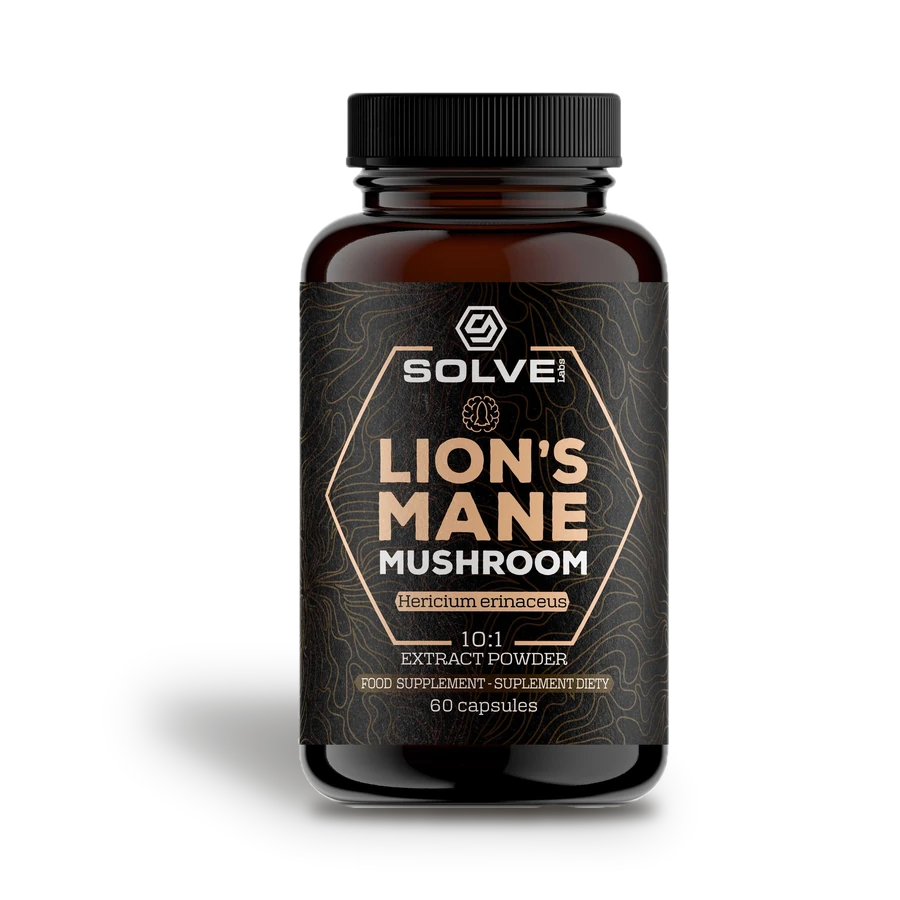
Pick up a jar of Lion’s Mane and turn it round. Which species is in it? Which part of the mushroom? How concentrated is the extract? Did a laboratory measure any of it?
Those were Jacob’s four questions. When he read the labels on the shelf, few of them answered all four.
So he built a company that answers those four questions first. That company is Solve Labs.
The man who explains fungi
Jacob explains the kingdom of fungi on Instagram, where he has published 695 posts about them. His videos cover Lion’s Mane, Reishi, Cordyceps, and mould and mycotoxins. They are in Polish.
The same habit runs through the company. We work with mycologists and manufacturers who put their numbers in writing, and we publish those numbers.

Four questions, four answers
- Which species? Hericium erinaceus. A DNA test at InventUR, at the University of Rzeszów, matched our extract at 99.2%.
- Which part? The fruiting body, the mushroom itself, grown on wood.
- How concentrated? 10:1. Ten kilos of mushroom become one kilo of extract. Each capsule holds 500 mg.
- Who measured it? Three independent laboratories. ALS measured the beta-glucans at 31.8%. GBA Polska checked heavy metals and microbiology.
What we found on other labels
In August 2026 we did Jacob’s exercise at scale and read 273 Lion’s Mane listings from 178 brands. 73% listed an ingredient that is not mushroom (194 of 264 readable labels). 8 of the 178 brands showed a lab report.

The jar
One ingredient in a plant-based capsule. Two capsules a day, after breakfast or with your first coffee. Lion’s Mane is the mushroom people take for focus, and there is no caffeine in it.
It is made in the EU and sold from Manchester. A jar is 60 capsules, 30 days, £1 a day. Your first order has a 60-day guarantee, even with the jar open.