
Mushroom Plant Protein: Nutrition Facts & What's Verified
Mushroom Plant Protein: Nutrition Facts & What's Verified
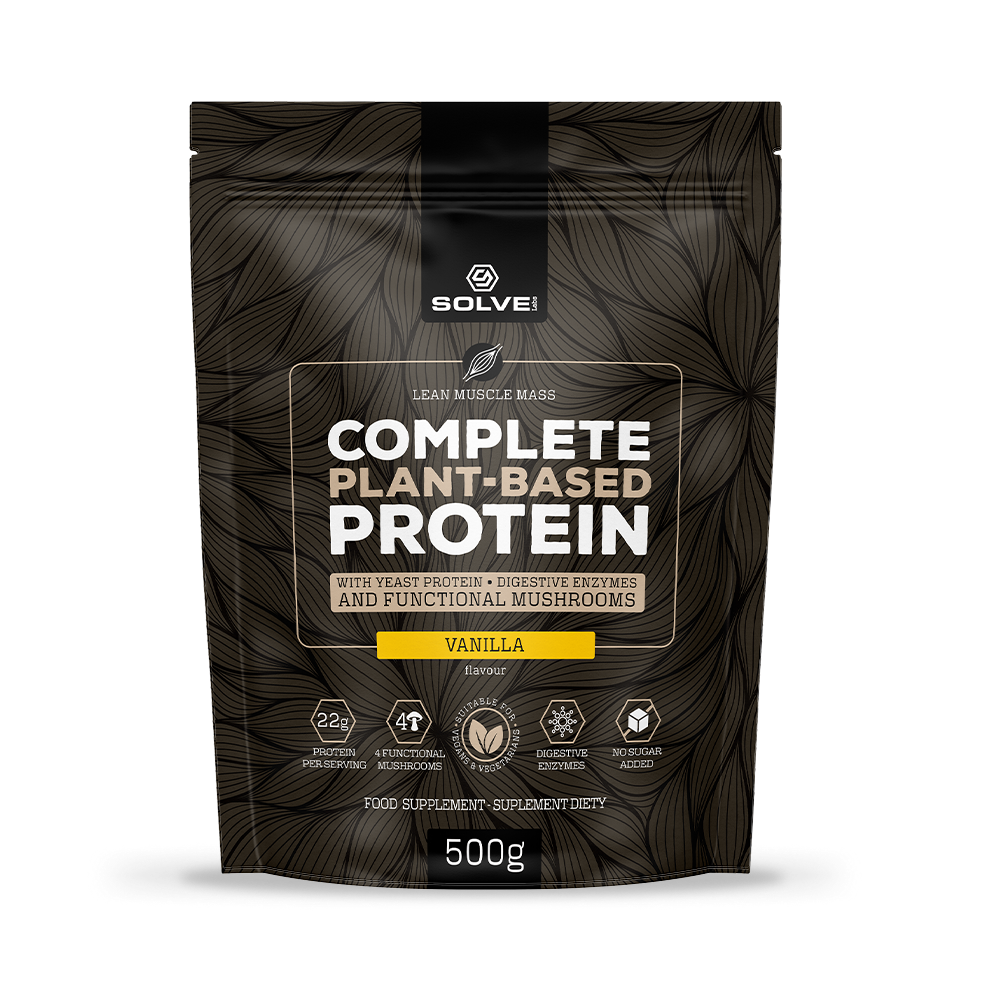
- Each 35g serving delivers 22g of complete protein from pea, rice, pumpkin, and yeast, a lean 62% protein-by-weight ratio at ~125 kcal.
- The four-source blend covers complementary amino acid gaps: pea's lysine + rice's methionine = a genuinely complete profile without soy or nuts.
- DigeZyme® (5-enzyme complex) offers a plausible mechanism against plant-protein bloating, but individual response varies.
- Lion's Mane, Reishi, Chaga, and Cordyceps are present but undosed, treat them as a bonus, not a verified functional hit.
- At a Glance: What the Label Proves vs. What It Doesn't
- What Are the 4 Plant Protein Sources, and Why Does That Combo Matter?
- Is the Amino Acid Profile Truly Complete for Muscle Building?
- What's the Full Macronutrient Breakdown Per Serving?
- How Does It Taste Compared to Standard Plant Proteins?
- Will DigeZyme® Actually Stop the Bloating from Pea Protein?
- How Much of Each Mushroom Extract Is Actually in Each Serving?
- Are the Mushroom Extracts Standardised for Active Compounds (e.g. % Beta-Glucans)?
- What Health Benefits Are Actually Supported, and Which Are Speculative?
- Is It Suitable for People with Nut or Soy Allergies?
- Can You Use This as a Meal Replacement, or Is It Strictly Post-Workout?
- The Two-Tier Rule: How to Judge Any Functional Protein Powder Honestly
This mushroom plant protein delivers 22g of complete protein per 35g serving from four complementary plant sources, with a lean 2.4g carbs and 3g fat. The protein and enzyme components are label-verified and backed by established science. The four functional mushrooms (Lion's Mane, Reishi, Chaga, Cordyceps) are real inclusions, but their per-serving doses are undisclosed, so efficacy claims for this specific blend can't be quantified. Buy it for the protein. Treat the mushrooms as a plausible bonus.
Evidence grade: moderate for protein and DigeZyme® components (label-specified); low for the mushroom blend (dosages undisclosed, no product-specific trial).
At a Glance: What the Label Proves vs. What It Doesn't
| Attribute | Detail | Evidence Strength |
|---|---|---|
| Protein per serving | 22g from pea, rice, pumpkin, yeast (35g serving) | Strong, label-specified |
| Carbohydrate / fat | 2.4g carbs / 3g fat per serving | Strong, label-specified |
| Amino acid profile | Complete (four-source blend) | Moderate |
| Functional mushrooms | Lion's Mane, Reishi, Chaga, Cordyceps | Low, doses undisclosed |
| Digestive support | DigeZyme® 5-enzyme complex | Moderate |
| Taste | Claimed "sweet, amazing", self-reported only | None, no independent review |
| Best for | Plant-eaters wanting dense protein + functional add-ons in one scoop | , |
What Are the 4 Plant Protein Sources, and Why Does That Combo Matter?
The 22g per serving comes from pea, rice, pumpkin, and yeast proteins. This isn't a cosmetic mix, it's nutritional engineering. Pea protein runs high in lysine but short on the sulphur-containing amino acids methionine and cysteine. Rice protein is the mirror image: rich in methionine, low in lysine. Pair them and each covers the other's gap. Pumpkin and yeast round out the profile further.
The result: a complete amino acid profile supplying all nine essential amino acids in usable proportions, the raw material muscle actually needs for repair and growth. Single-source plant proteins struggle here. The four-source approach solves it cleanly.
Is the Amino Acid Profile Truly Complete for Muscle Building?
Based on the formulation: yes. The legume-plus-grain pairing (pea + rice) is the classic fix for completeness in plant protein, well-established in sports nutrition literature. Muscle protein synthesis depends on all nine essential amino acids being present simultaneously, with leucine acting as the primary trigger.
One honest limit: the published serving data doesn't break out a full per-amino-acid gram table. If you're targeting a specific leucine threshold, say, ~2.5-3g per serving for maximal MPS stimulation, request the manufacturer's full amino acid panel to confirm it. Don't assume; verify.
What's the Full Macronutrient Breakdown Per Serving?
| Nutrient | Per 35g Serving |
|---|---|
| Protein | 22g |
| Carbohydrate | 2.4g |
| Fat | 3g |
| Estimated calories | ~125 kcal |
| Protein-to-weight ratio | 62% |
| Protein sources | Pea, rice, pumpkin, yeast |
| Added enzymes | DigeZyme® (5 enzymes) |
Run the energy math: 22g protein (~4 kcal/g) + 2.4g carbs (~4 kcal/g) + 3g fat (~9 kcal/g) lands near ~125 kcal per scoop, lean by any standard. At 62% protein by weight, this is a dense, protein-forward powder, not a scoop of mostly filler.
How Does It Taste Compared to Standard Plant Proteins?
Standard plant proteins earn their bad reputation for a specific chemical reason. Pea and rice isolates carry bitter, earthy, chalky notes from their saponin and legume content. Manufacturers usually bury those notes under sugar or heavy artificial sweeteners, trading off-flavor for sugar bomb.
The brand claims a "sweet and truly amazing taste" that "surpasses other standard plant-based protein supplements." That's a manufacturer claim, not a blind sensory panel, not a third-party review. No independent taste study of this product exists. Weight the claim accordingly.
Two formulation facts make a cleaner taste plausible, though:
- Multi-source blending dilutes off-notes. Pumpkin and yeast proteins run milder and savory-neutral, softening pea's signature bitterness.
- Low-sugar base reads cleaner. At just 2.4g carbs, this isn't a dessert-mimicking formula, but with no sugar to hide behind, any added natural flavoring has to carry the full experience.
If a gritty, bitter shake soured you on plant protein before, the multi-source blend is a legitimate reason to retry the category. Just treat "amazing taste" as a hypothesis to test on yourself, not a proven fact.
Will DigeZyme® Actually Stop the Bloating from Pea Protein?
The formula includes DigeZyme®, a five-enzyme complex, the single most evidence-informed answer to the most common plant-protein complaint. The mechanism holds up: DigeZyme® supplies protease (breaks down protein), amylase, lactase, cellulase, and lipase, enzymes that help dismantle the fibers and proteins that otherwise ferment in your gut and produce gas.
The honest caveat: much plant-protein bloating stems from fermentable fibers and oligosaccharides in pea and legume material, and enzyme efficacy against those varies person to person. DigeZyme® is a smart, evidence-informed inclusion, not a guarantee. A short adaptation window of one to two weeks is normal with any new protein formula. It usually settles.
How Much of Each Mushroom Extract Is Actually in Each Serving?
This is the product's central limitation, no soft-pedaling: the per-serving milligram doses of Lion's Mane, Reishi, Chaga, and Cordyceps are not disclosed in available sources. Without those numbers, no mechanism-based efficacy claim for this product's mushroom content can be quantified. Therapeutic dose or trace inclusion, the label doesn't tell you.
Here's why the number matters. Functional mushroom benefits are dose- and extraction-dependent. Human studies use defined amounts, and the active compounds, beta-glucans, hericenones, cordycepin, live in specific fractions that crude mushroom powder may barely contain. A blend listed by name but not by dose or standardization percentage cannot be assumed to match trial-level exposure.
Are the Mushroom Extracts Standardised for Active Compounds (e.g. % Beta-Glucans)?
No standardization percentage is stated in available sources, no % beta-glucans for Reishi and Chaga, no % cordycepin for Cordyceps. Standardization is what separates a genuine extract from filler biomass. Beta-glucans are the immune-modulating polysaccharides most Reishi and Chaga research credits for benefit, and their concentration swings enormously by extraction method. Hot-water extraction pulls them out; simple milled powder often doesn't. Without a disclosed figure, don't assume clinical-grade potency, verify it with the manufacturer directly.
What Health Benefits Are Actually Supported, and Which Are Speculative?
Separating well-backed from preliminary, because those are not the same tier:
- Muscle maintenance and recovery (moderate evidence). The complete four-source amino acid profile supplies what muscle protein synthesis requires. This is the product's strongest, most defensible benefit, grounded in established protein science.
- Reduced digestive discomfort (moderate evidence). DigeZyme®'s protease and carbohydrase enzymes carry a plausible, well-understood mechanism for easing plant-protein bloating, individual response varies, but the science is real.
- Cognitive support via Lion's Mane (weak/preliminary for this product). Lion's Mane contains hericenones and erinacines that stimulate nerve growth factor (NGF) synthesis, supporting neuron maintenance; early studies suggest potential for cognitive decline and nerve repair. The dose here is undisclosed, presence in the blend does not equal an effective dose.
- Exercise stamina via Cordyceps (weak/preliminary). Cordyceps may improve ATP production and oxygen utilisation, with potential upside for stamina and recovery, though most evidence stays preliminary and rarely comes from large human trials.
- Calming and immune support via Reishi (weak/preliminary). Reishi is rich in immune-modulating polysaccharides and studied for calming effects and blood-sugar modulation. Undisclosed dose caps the confidence here too.
A 2026 WIRED review of functional mushroom supplements notes that while Cordyceps and Lion's Mane show promising preliminary data, many claims lack robust human-trial validation, and supplement quality swings widely by extraction method and dosage. No study has tested this specific blend for cognitive, performance, or adaptogenic outcomes.
Is It Suitable for People with Nut or Soy Allergies?
The four protein sources, pea, rice, pumpkin, yeast, contain no soy, no tree nuts, no peanuts. That's a real advantage over the many plant proteins that default to soy. But allergy safety hinges on two things: the full ingredient list and the manufacturing facility's cross-contamination controls. Neither is fully specified in available sources. If you have a diagnosed allergy, confirm the complete label and allergen statement with the manufacturer before your first scoop. Don't guess with an allergy.
Can You Use This as a Meal Replacement, or Is It Strictly Post-Workout?
At ~125 kcal and 22g protein with minimal carbs and fat, this is a protein supplement, not a complete meal replacement. It lacks the calorie load, carbohydrate energy, and micronutrient fortification a true meal-replacement shake carries.
Where it performs best:
- Post-workout, to supply recovery amino acids fast
- Between-meal protein top-up, to hit daily targets without extra calories
- Blended into a smoothie with fruit, oats, or nut butter, to build it toward meal-replacement territory
Lean on it as a standalone meal repeatedly, and you'll come up short on total calories and micronutrients. Use it as the protein anchor of a larger meal, that's the play.
The Two-Tier Rule: How to Judge Any Functional Protein Powder Honestly
Here's a framework worth keeping. Split every claim on a functional protein label into two tiers.
- Tier 1, What the label proves: gram weights, macros, named enzyme complexes with established mechanisms. For this product, that means 22g complete protein, a lean macro profile, and DigeZyme® for digestive support. Solid ground.
- Tier 2, What requires more data: any functional mushroom benefit tied to an undisclosed dose or unstandardized extract. For this product, that's all four mushrooms. Plausible additions, not verified doses.
Peak wellness starts with knowing which tier you're standing on. This product earns its place in Tier 1. The mushrooms are a reason to stay curious, not a reason to pay a premium you can't justify yet.
Frequently asked questions
Does this mushroom plant protein contain all essential amino acids?
Yes, the four-source blend (pea, rice, pumpkin, yeast) delivers a complete amino acid profile. Pea's lysine and rice's methionine complement each other directly, covering the gaps that make single-source plant proteins incomplete. A full per-amino-acid breakdown isn't publicly disclosed, so confirm the leucine content with the manufacturer if you're targeting specific MPS thresholds.
How many milligrams of Lion's Mane, Reishi, Chaga, and Cordyceps are in each serving?
The per-serving milligram doses of all four mushroom extracts are not disclosed in available sources. Without those figures, and without knowing whether extracts are standardized for active compounds like beta-glucans or cordycepin, it's impossible to compare them to the doses used in human trials. Treat the mushrooms as a bonus inclusion, not a verified functional dose.
Will DigeZyme® prevent the bloating I usually get from pea protein?
DigeZyme® is a five-enzyme complex (protease, amylase, lactase, cellulase, lipase) with a well-understood mechanism for improving plant protein digestion and reducing gas from fermentable fibers. It's an evidence-informed inclusion, but not a universal guarantee. Individual response varies, and a short adaptation window of one to two weeks is normal with any new protein formula.
Disclaimer: These statements have not been evaluated by the Food and Drug Administration. This product is not intended to diagnose, treat, cure, or prevent any disease. Consult a healthcare professional before use.
