
Does DigeZyme Prevent Pea Protein Bloating?
Does DigeZyme Prevent Pea Protein Bloating?
- Pea protein bloating is driven mostly by fermentable fibre and undigested amino acids reaching the lower gut, high-quality isolates remove most of that fibre (DIAAS ~0.82).
- The strongest bloating evidence isn't for enzymes alone: a xyloglucan + pea protein combination cut abdominal girth by 4.7 cm vs 1.8 cm for simethicone in a randomised trial.
- An enzymes-probiotics blend (Pepzyme Pro) sped up amino acid absorption (Tmax) for alanine (p=0.021) and glycine (p=0.023), meaning less substrate left over to ferment.
- Proteolytic enzymes like those in DigeZyme® are mechanistically plausible for reducing protein-driven bloating, but no published trial validates a product named 'DigeZyme' or 'Solve Labs' specifically, expect help, not a cure.
- Why pea protein bloats you
- What DigeZyme® is and what it does
- Will DigeZyme® actually stop pea-protein bloating?
- The evidence, and where it's weak
- How much you need, and how fast it works
- Is the protein blend actually complete?
- Health benefits, mechanism and evidence grade
- DigeZyme® vs the other bloating fixes
- Who should take it, and who should hold off
- Related guides
Yes, a DigeZyme® enzyme complex can reduce the bloating pea protein gives you, and here's the honest version of why. Pea protein bloating is a digestion problem, not an allergy. Undigested protein and fermentable fibre slip past your small intestine, hit your colon, and bacteria ferment them into gas. DigeZyme®, a five-enzyme complex, breaks those macronutrients down higher up, so less substrate reaches the colon to ferment. The mechanism is sound and the kinetic data backs it. But be clear on the limit: the single strongest clinical result for pea-protein bloating comes from a xyloglucan + pea protein combination (−4.7 cm abdominal girth), and no published trial tests a product named "DigeZyme" or "Solve Labs" by name. Mechanistically plausible, partly evidenced, not a guaranteed cure. That's the whole truth, and it's the standard we hold ourselves to.
| Factor | Detail |
|---|---|
| What DigeZyme® is | A standardised five-enzyme complex, amylase, protease, lipase, cellulase, lactase |
| Target problem | Gas and fullness after plant protein, driven by colonic fermentation of undigested residue |
| Key mechanism | Protease cleaves protein into absorbable peptides before it reaches the fermenting colon |
| Strongest bloating evidence | Xyloglucan + pea protein: −4.7 cm girth in 20 days vs −1.8 cm for simethicone |
| Enzyme-specific evidence | Faster time-to-peak for alanine (p=0.021) and glycine (p=0.023) with pea protein |
| Who it's for | People who get gas/fullness from plant protein but tolerate the protein itself |
| Evidence strength | Moderate for enzyme/probiotic blends; brand-specific claims: unvalidated |
Why pea protein bloats you
Pea protein slows gastric emptying and fires the satiety hormones CCK and GLP-1. Great for appetite, but the same slowed transit leaves protein and fibre incompletely digested. What isn't absorbed in the small intestine lands in the colon. Bacteria ferment it. Out comes hydrogen, methane and CO₂. That gas is the bloat. Simple chain of cause and effect, and every fix on the market targets one link in it.
Two variables decide how much residue reaches your colon. Isolate quality first. A high-quality pea protein isolate scores a DIAAS of roughly 0.82, meaning most of its amino acids get transported across the gut lining instead of wasted downstream. Isolation strips out the fibrous carbs that feed fermentation. That's why a cheap pea concentrate bloats far worse than a well-made isolate, same plant, different processing. Processing second. In vitro data shows heat treatment can drive pea protein to form aggregates up to 50% less digestible than untreated protein. Poorly processed protein bloats more.
Here's the reset most brands won't give you: much of the difference between a bloaty pea protein and a comfortable one is decided by the raw material, before any additive touches it.
What DigeZyme® is and what it does
DigeZyme® is a branded, standardised multi-enzyme complex. It supplies five enzyme classes, each cleaving a different macronutrient: protease (protein → peptides and amino acids), amylase (starch → sugars), lipase (fats → fatty acids), cellulase (fibrous cellulose), and lactase (lactose, relevant only if you blend with dairy). For plant-protein bloating, two do the real work: protease cuts the leftover protein reaching your colon, and cellulase breaks down some of the residual fibre.
The mechanism, stated plainly: enzymes speed up hydrolysis in the small intestine, so fewer intact molecules reach colonic bacteria, and less fermentation means less gas. That premise is solid. What it can't tell you is how much of the effect survives real-world digestion. For that, you need trial data, so let's look at it.
Will DigeZyme® actually stop pea-protein bloating?
Here's the calibrated answer, benefit and limit together. The most directly relevant trial used Pepzyme Pro, an enzyme-probiotic blend, in a 15-day randomised, double-blind crossover with pea protein. It significantly cut the time to peak amino acid concentration (Tmax) for alanine (p=0.021) and glycine (p=0.023). Faster absorption means less unabsorbed substrate for fermentation, the exact upstream cause of your bloat. That's mechanistic confirmation: an enzyme blend can change how pea protein digests.
A second study added the probiotic BIOHM FX to 15 g of pea protein. It shifted the microbiome (elevating species such as Galactomyces geotrichum) and raised essential amino acid absorption versus pea protein alone (P=0.047 at 120 minutes). Self-reported bloating dropped over time, but note the caveat before you get excited: that's a main effect of time, not proof the probiotic beat placebo on bloating specifically.
The strongest bloating-specific result belongs to neither enzymes nor probiotics. A double-blind, multicentre randomised trial of a xyloglucan + pea protein combination reduced abdominal girth by 4.7 cm over 20 days, versus 1.8 cm for simethicone, in patients with functional abdominal bloating and distension (RCT source). Xyloglucan forms a protective film over the gut lining; the pea protein reinforced a mucosal barrier effect. Different mechanism entirely from digestive enzymes, worth knowing, so you don't assume every "pea protein bloating" product works the same way.
Bottom line: a DigeZyme®-type enzyme complex is mechanistically plausible and backed by kinetic data from analogous blends, but no published trial tests DigeZyme® by name, at a specific dose, with a specific protein. Treat it as a smart aid, not a validated cure.
The evidence, and where it's weak
| Approach | Best finding | Design | Strength |
|---|---|---|---|
| Xyloglucan + pea protein | −4.7 cm girth vs −1.8 cm simethicone (20 days) | Double-blind, multicentre RCT | Strong (bloating endpoint) |
| Enzymes-probiotics (Pepzyme Pro) | Faster Tmax: alanine p=0.021, glycine p=0.023 | 15-day randomised crossover | Moderate (surrogate marker) |
| Probiotic (BIOHM FX) + 15g pea protein | Higher EAA absorption, P=0.047 at 120 min | Clinical study | Moderate for absorption; weak for bloating |
| High-quality isolate alone | DIAAS ~0.82; less fibre reaching colon | Compositional/nutritional data | Indirect |
| Plain pea protein "solves" bloating | , | , | Weak / not supported |
Say the quiet part out loud: the enzyme evidence measures digestion speed (Tmax), not bloating directly. The strongest direct bloating data comes from xyloglucan, a different ingredient. And "pea protein solves bloating" as a standalone claim isn't supported. Pea protein can itself cause GI distress through its fibre. That's precisely why isolate quality and the right adjuncts matter.
How much you need, and how fast it works
DigeZyme® is typically dosed at 50-100 mg per serving. But read the label closely, the enzyme activity, measured in units (protease in HUT, for example), tells you more than the milligram weight. Standardisation is the number that counts.
Unlike a mushroom adaptogen that builds up over weeks, digestive enzymes act on the meal in front of them. They should influence that serving's digestion within roughly 30-60 minutes. So take the enzyme with the protein, not hours apart. Timing is not optional here.
Now manage the timeline honestly. If your bloat is undigested protein or fibre, an effective enzyme dose can help from the first serving. If it's an intolerant microbiome over-fermenting, the probiotic-style benefit is gradual, the BIOHM FX and Pepzyme Pro studies ran 15 days precisely because microbiome shifts take that long. Mild symptoms in week one or two, soft stools, transient gas, are common as your gut adjusts. That's adaptation, not failure.
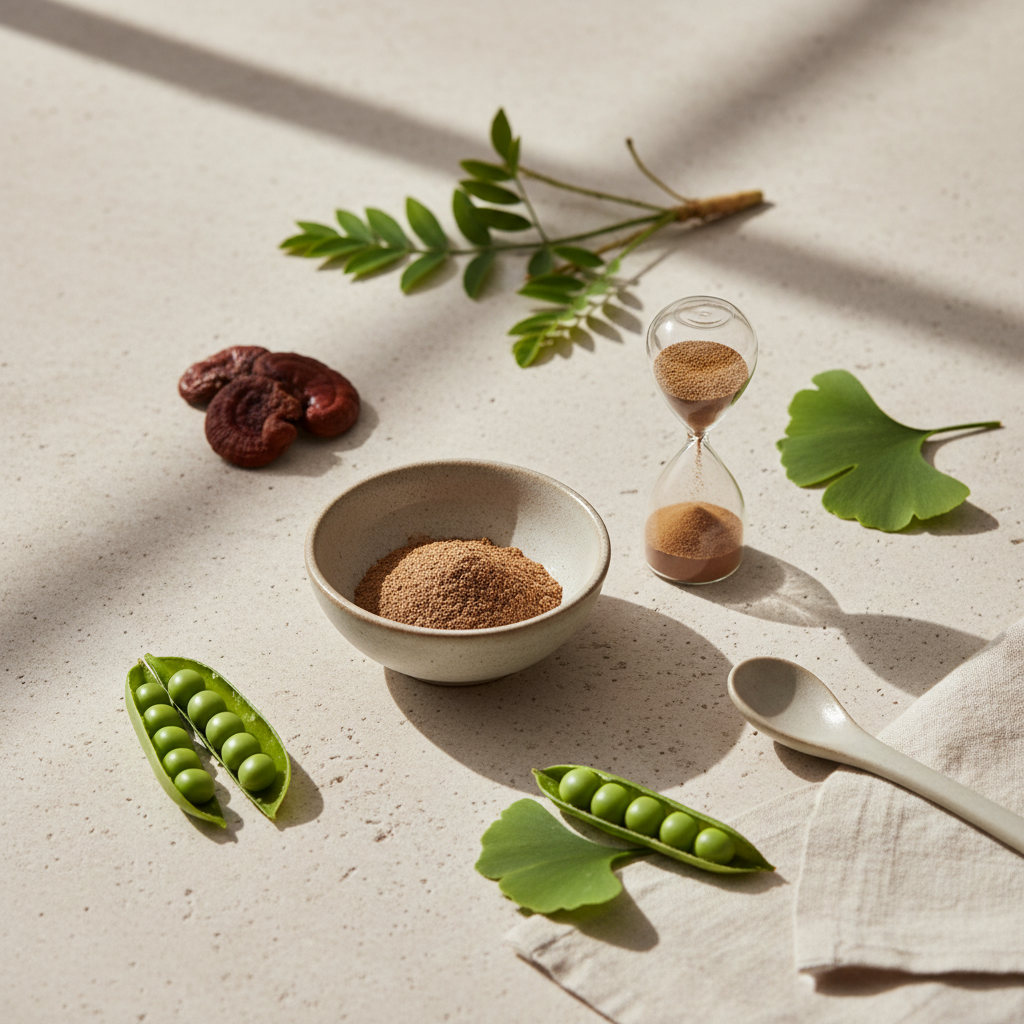
Is the protein blend actually complete?
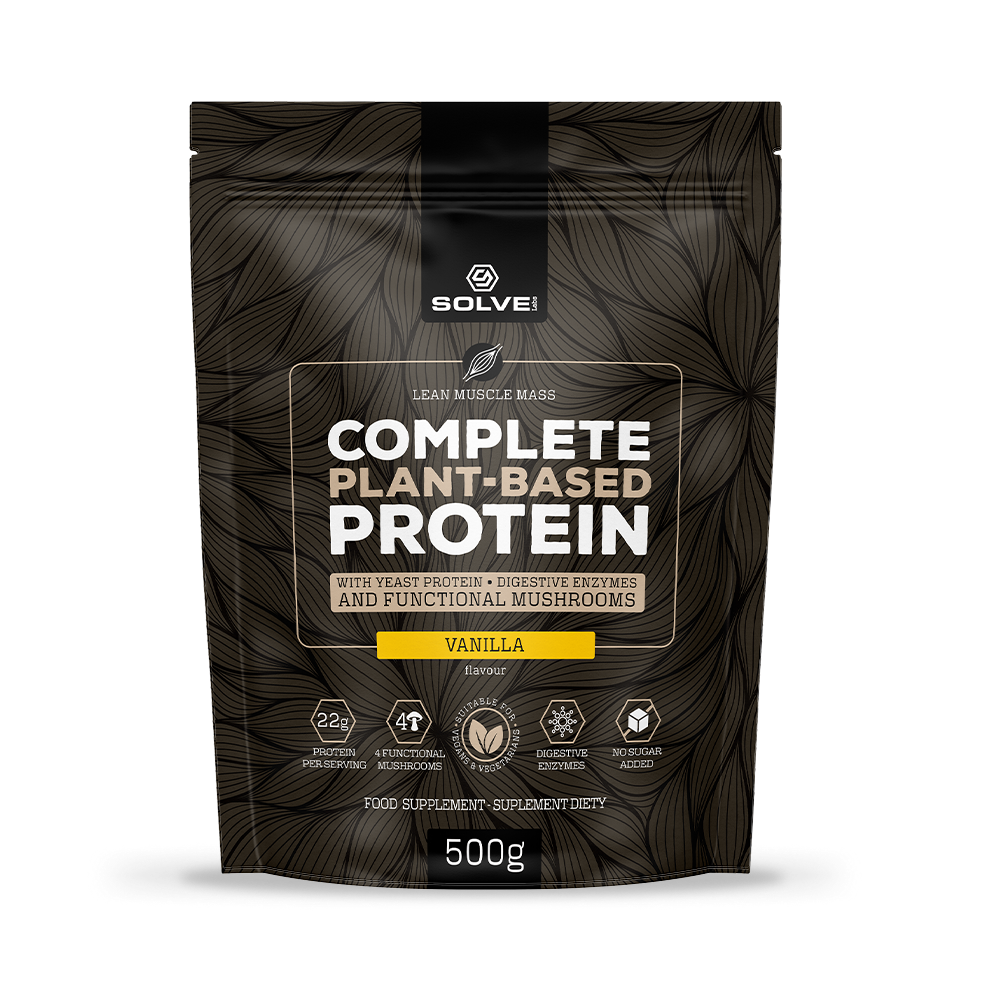
A four-source plant protein blend delivering 22 g per serving is built to cover the amino acid gaps single-source proteins leave. Pea is naturally low in methionine. Rice is low in lysine but rich in methionine. Combine them and you close the gaps, a standard, evidence-based way to build all nine essential amino acids into one scoop. The number that matters for absorption is DIAAS: a good pea isolate sits near 0.82, and blending tends to lift the combined score.
Two things to verify on any label before you buy, because opacity is this category's most common complaint:
- Named amounts, not a "proprietary blend." If the four protein sources and the mushroom extracts hide inside one blend weight, you cannot confirm whether the actives sit at therapeutic doses or token sprinkles.
- Standardisation for the mushrooms. Lion's Mane, Reishi, Chaga and Cordyceps extracts should state a beta-glucan percentage, the active polysaccharide, not just "mushroom extract." No percentage, no verifiable potency.
Solve Labs' Mushroom Plant-Based Protein pairs the four-source protein and DigeZyme® with those extracts, and it's useful only to the degree it discloses per-ingredient amounts and standardisation. That's the same bar we'd tell you to hold every brand to, ours included.
Health benefits, mechanism and evidence grade
- Less digestive discomfort from protein. Mechanism: protease reduces undigested protein reaching the fermenting colon; faster Tmax means less substrate for gas. Evidence: moderate, supported by Pepzyme Pro kinetic data, not DigeZyme®-specific bloating trials.
- Muscle protein synthesis and recovery. Mechanism: a complete four-source amino acid profile supplies leucine and the other EAAs that trigger MPS. Evidence: strong for adequate-protein diets generally, the blend's value hinges on hitting a sufficient leucine/EAA dose per serving.
- Better amino acid absorption with enzymes/probiotics. Mechanism: enzymes speed hydrolysis; probiotics reshape the microbiome. Evidence: moderate, EAA absorption rose significantly with BIOHM FX (P=0.047 at 120 min).
- Cognitive and immune support from mushrooms. Mechanism: Lion's Mane on nerve growth factor pathways; beta-glucans from Reishi/Chaga on immune modulation; Cordyceps on ATP and oxygen utilisation. Evidence: weak-to-emerging, most human data uses far higher standalone doses than a protein powder carries. Treat these as bonuses, not the reason you buy.
DigeZyme® vs the other bloating fixes
If bloating is your only concern, the comparison is decisive. Simethicone, the antacid-aisle standard, moved abdominal girth just 1.8 cm in the trial where xyloglucan + pea protein hit 4.7 cm. An anti-gas tablet is the weaker play against a distension endpoint. A digestive enzyme attacks an upstream cause, incomplete digestion, rather than dispersing gas after it forms. That's the more logical fix for protein-specific bloating. And the simplest move of all: switch to a higher-quality isolate and strip the fibre out before it ferments. That often beats any additive on its own. The most robust strategy stacks all three, a clean isolate plus an enzyme, taken with the meal.
Who should take it, and who should hold off
This suits people who tolerate plant protein but get gas or fullness afterward, and who want recovery-grade protein without dairy. High-quality pea isolate is hypoallergenic and free of the top allergens, so it generally works for those avoiding whey, but still check the label for a "may contain" nut or soy statement from shared facilities. Caution is advised if you have a diagnosed GI condition. Enzymes are not a substitute for medical management of IBS or IBD, and you should clear supplements with your clinician first. And if bloating persists beyond two to three weeks despite a quality isolate and enzymes, that's a signal to investigate an underlying cause, not to buy more product.
Frequently asked questions
Does DigeZyme® guarantee I won't bloat from pea protein?
No. DigeZyme®-type enzyme complexes are mechanistically sound, protease breaks protein down before it reaches the fermenting colon, and analogous blends like Pepzyme Pro sped amino acid absorption (Tmax for alanine p=0.021, glycine p=0.023). But no published trial validates DigeZyme® by name for bloating, and the strongest bloating result (−4.7 cm girth) came from xyloglucan, a different ingredient. Expect help, not a guarantee.
Is a four-source plant protein blend really complete?
Yes, when the sources complement each other. Pea protein is low in methionine while rice protein is rich in it and low in lysine; combining four sources covers all nine essential amino acids. A good pea isolate alone has a DIAAS of about 0.82, and blending typically raises the combined score. Verify the label lists each source's amount rather than hiding them in a single proprietary blend weight.
How quickly should a digestive enzyme work?
Enzymes act on the meal they're taken with, so take DigeZyme® alongside the protein, you should notice easier digestion within roughly 30-60 minutes for that serving. If your bloating stems from an over-fermenting microbiome, the improvement is gradual; the Pepzyme Pro and BIOHM FX studies ran 15 days for that reason. Mild gas or soft stools in the first one to two weeks are common adjustment effects.
Disclaimer: These statements have not been evaluated by the Food and Drug Administration. This product is not intended to diagnose, treat, cure, or prevent any disease. Consult a healthcare professional before use.
