
Mushroom Coffee + Ashwagandha vs. Capsules
Mushroom Coffee + Ashwagandha vs. Capsules
- Capsules deliver the clinically validated 300-600 mg of ashwagandha root extract (≥5% withanolides); most coffee blends deliver sub-therapeutic amounts (often <100 mg).
- Ashwagandha capsules have human RCT evidence for ~20-30% cortisol reduction; no human trials confirm brewed mushroom coffee reaches the same effect.
- Coffee's real, mechanism-backed edge is behavioral: a daily ritual plus typically ~50% less caffeine, not proven synergy between mushrooms, ashwagandha, and coffee.
- Watch two distinct risks: high-oxalate Chaga (kidney-stone concern) in coffee, and thyroid influence (T4-to-T3, TSH) with ashwagandha capsules.
- At a glance: coffee blend vs. capsules
- What is ashwagandha mushroom coffee, and how is it different from a capsule?
- How much ashwagandha do you actually need — and does coffee deliver it?
- What does the evidence say about each format?
- Why a beverage may under-deliver the mushroom actives
- So what is the coffee actually good for?
- Health benefits, with mechanism and evidence grade
- How long until either one works?
- Side effects and risks
- Which should you choose?
- How to vet a blend before buying
If your goal is a measurable drop in stress hormones, ashwagandha capsules win, they let you hit the dose the trials actually used. Human trials that lowered serum cortisol by roughly 20-30% in stressed adults used 300-600 mg of root extract standardized to at least 5% withanolides [3][2]. Ashwagandha mushroom coffee wins on a different axis, a lower-caffeine daily ritual you'll actually stick to, but the ashwagandha per cup is frequently under 100 mg, often undisclosed, and no human trial has confirmed the brewed blend reproduces what the capsule does [1][2]. Short version: capsules are the dose, coffee is the habit.
Provenance: Every benefit below is graded against human clinical evidence and labeled "mechanistic" or "unproven" where trials don't exist. Reviewed and fact-checked by the Solve Labs research team against the four cited sources; last reviewed for evidence strength on publication.
At a glance: coffee blend vs. capsules
| Factor | Ashwagandha Mushroom Coffee | Ashwagandha Capsules |
|---|---|---|
| Typical ashwagandha dose | Often <100 mg, frequently undisclosed [2] | 300-600 mg root extract, ≥5% withanolides [2][3] |
| Key actives | Withanolides + mushroom beta-glucans/hericenones + caffeine | Standardized withanolides only |
| Cortisol evidence | No human trials on the brewed blend [1] | Strong: ~20-30% reduction in stressed adults [3] |
| Caffeine | Often ~50% less than regular coffee [1] | None |
| Best for | Habit-forming ritual, gentler energy, lower caffeine | Precise, verifiable dosing for stress support |
| Notable caution | Kidney-stone concern if high-oxalate Chaga present [1] | May influence thyroid markers — monitor [2] |
| Evidence strength | Weak / indirect | Strong for stress; moderate elsewhere |
What is ashwagandha mushroom coffee, and how is it different from a capsule?
It's a beverage blend, ground or instant coffee, one or more mushroom extracts (usually Chaga, Lion's Mane, Reishi, or Cordyceps), and a dose of ashwagandha (Withania somnifera) root. Ashwagandha is an adaptogen, a compound that helps buffer your stress response, and its active constituents are the steroidal lactones called withanolides [2].
A capsule is a single-ingredient, dose-defined vehicle, a fixed milligram amount standardized to a stated withanolide percentage. The coffee is a crowded cup where coffee, mushrooms, and ashwagandha all compete for one small serving volume. That's exactly where the dosing problem starts.
How much ashwagandha do you actually need — and does coffee deliver it?
Ashwagandha works through one mechanism, withanolides dialling down your HPA-axis (hypothalamic-pituitary-adrenal) stress response, and dose is everything. The trials that moved cortisol used 300-600 mg of root extract standardized to ≥5% withanolides [3][2]. Below that, the effect isn't reliably demonstrated.
Now the honest arithmetic. A capsule prints its dose on the label, say 600 mg at 5% withanolides, which is 30 mg of withanolides. A coffee blend, boxed in by cup volume and flavor, often carries under 100 mg of ashwagandha, and frequently buries it inside a proprietary blend that never states the individual amount [2]. If your cup holds 80 mg at an unstated potency, you simply cannot confirm you're near the studied threshold.
| Format | Extract per serving | Withanolides (at 5%) | In the studied 300-600 mg range? |
|---|---|---|---|
| Standard capsule | 300-600 mg | 15-30 mg | Yes |
| Typical coffee blend | <100 mg (often undisclosed) | <5 mg | Usually no |
The rule of thumb: if the label doesn't state milligrams of ashwagandha and the withanolide percentage, treat the product as complementary, not therapeutic [2].
What does the evidence say about each format?
Marketing tends to blur two separate questions, does ashwagandha work? and does this coffee work? They have very different answers.
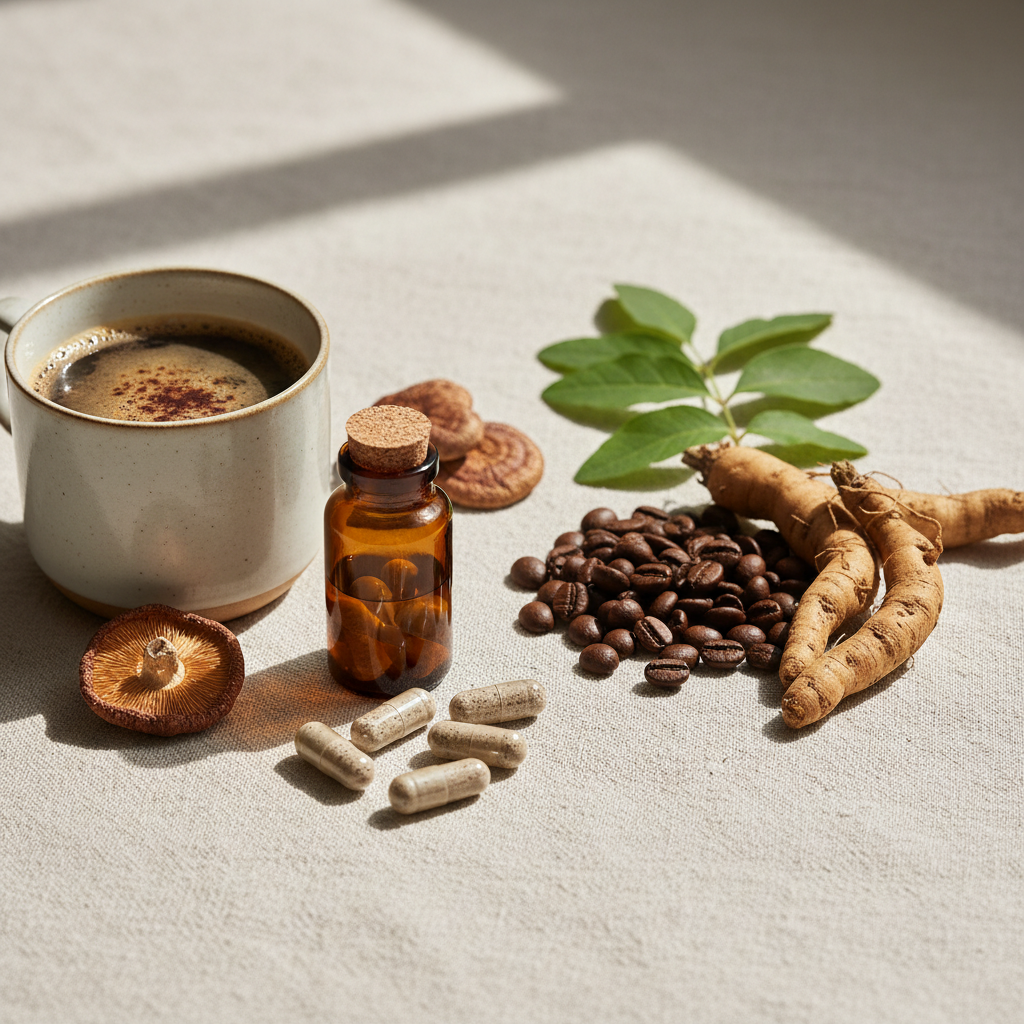
Ashwagandha at capsule doses: strong evidence. Standardized root extract may support a healthy stress response by helping lower serum cortisol, on the order of 20-30% in stressed adults across controlled trials, through HPA-axis modulation [3]. As adaptogen findings go, this is one of the better-supported ones.
The mushroom coffee blend: weak, indirect evidence. No published human trial has tested whether combining mushrooms, ashwagandha, and coffee produces a synergistic effect, or whether the finished drink retains each ingredient's activity [1]. Claims that mushroom coffee treats anxiety or depression are not supported by clinical evidence, and it should not be positioned as a treatment for any condition [1]. It's also unconfirmed that drying, extracting, and brewing preserve the mushrooms' bioactives intact [1].
Lion's Mane, specifically. A human study found that Hericium erinaceus supplementation was associated with improvements on cognitive measures over the trial period [4]. But that evidence belongs to the supplement taken at capsule-grade doses, not to Lion's Mane brewed into coffee, which hasn't been studied for cognition in that form. Don't let the coffee borrow the capsule's data.
Why a beverage may under-deliver the mushroom actives
Two mechanisms, both working against the cup. First, brewing, hot water may fail to fully release or may degrade key compounds like hericenones (Lion's Mane) and beta-glucans (Reishi), and there's no confirmation the benefits survive the drying-extracting-brewing pipeline [1]. Second, format quality, many commercial blends use low-bioavailability extracts, or mycelium-on-grain rather than fruiting body, then mask a thin formulation with sweeteners. Without dual-extracted fruiting-body mushrooms and standardized ashwagandha, the beverage is best read as a complementary wellness product rather than a therapeutic dose [2].
So what is the coffee actually good for?
Its most defensible benefit is mechanical, not molecular. Mushroom coffee often carries around 50% less caffeine than regular coffee, which can mean less jitter and, by lowering your evening stimulant load, may support sleep quality regardless of what the mushrooms are doing [1]. A capsule can't cut your caffeine intake; you take it alongside your usual brew. So if you want gentler energy plus a stress-supportive habit in one cup, the format itself does something a pill can't.
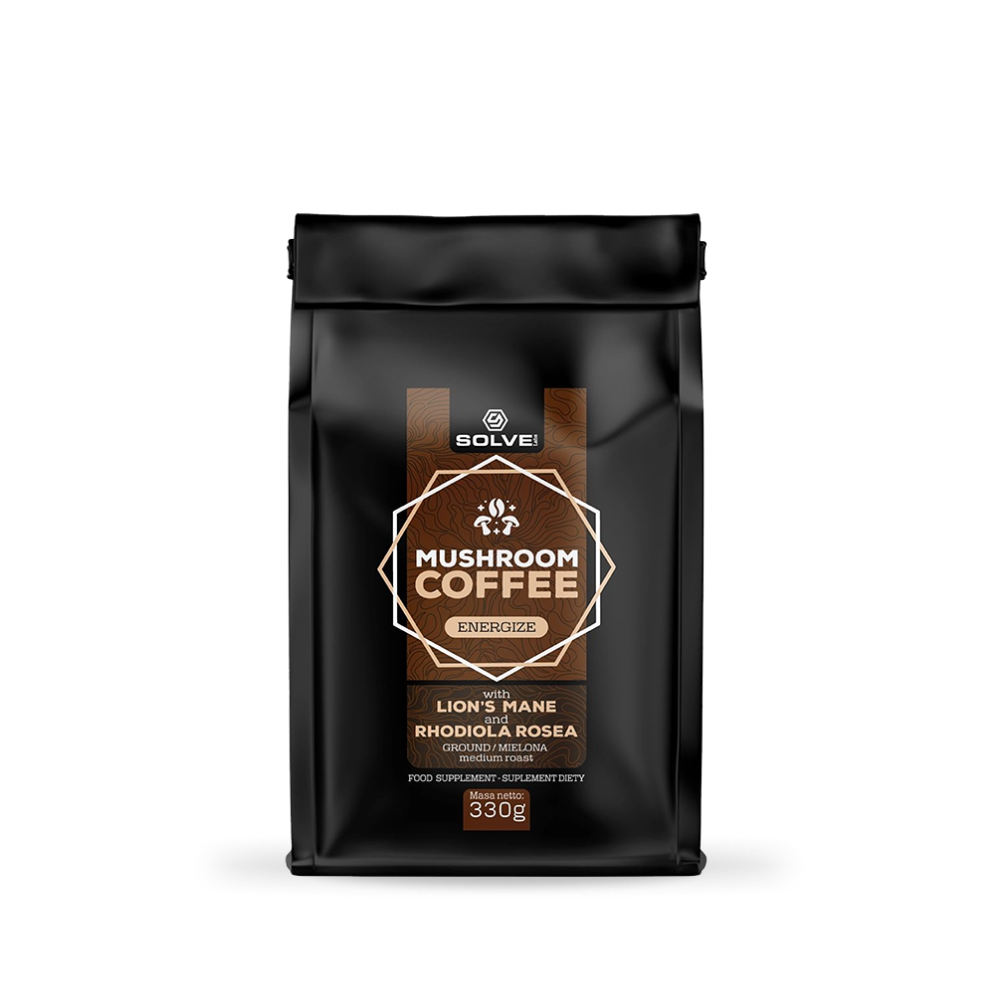
The second real benefit is behavioral, and it's underrated. Adherence is the silent variable in every supplement: a dose you skip does nothing. Folding an adaptogen into a coffee you already drink every morning is far harder to forget than a bottle in a cabinet. That's the slot a product like Solve Labs' Chaga & Ashwagandha Mushroom Coffee is built for, adaptogens alongside caffeine for combined energy and stress support in one morning drink, most usefully as a complement to, not a replacement for, dose-controlled supplementation when a real cortisol effect is the goal.
Health benefits, with mechanism and evidence grade
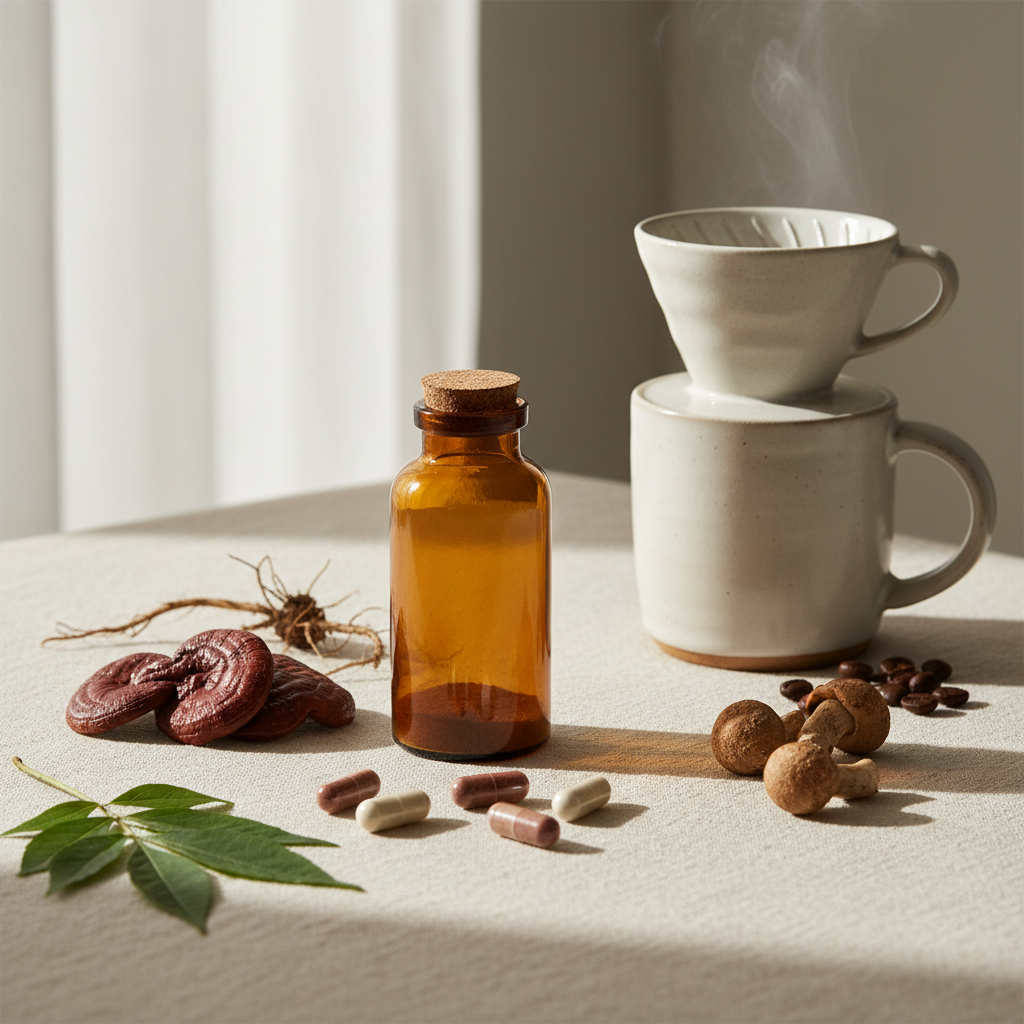
- Stress and cortisol support (ashwagandha) — Strong. Withanolides modulate the HPA axis, so serum cortisol tends to fall by roughly 20-30% in stressed adults at 300-600 mg of standardized extract [3]. It's dose-dependent, which is why it's reliable mainly in capsule form.
- Sleep quality — Moderate. Ashwagandha may support sleep by easing stress-driven arousal [2]; the coffee may help indirectly by cutting caffeine ~50% [1]. Two different mechanisms, neither guaranteed at low doses.
- Cognitive support (Lion's Mane) — Moderate for the supplement, unproven for the coffee. Human supplementation has been associated with cognitive-score improvements [4], but brewed-in-coffee delivery hasn't been tested for cognition.
- Gentler, lower-jitter energy — Moderate (mechanical). The reduced caffeine does this, not the mushrooms [1].
- Immune and recovery claims (Reishi, Cordyceps) — Weak in beverage form. A per-ingredient rationale exists, but no trial confirms the finished drink retains it [1].
Where the evidence is thin, we'll say so plainly, the beverage's synergy story is a hypothesis, not a finding [1].
How long until either one works?
Set expectations against the biology. Ashwagandha's stress and cortisol effects in trials build over weeks of daily dosing, HPA-axis modulation is cumulative, not overnight [3]. The "gentler energy" from the coffee, by contrast, is felt within the hour, because that's caffeine, and caffeine is fast. Here's the trap: switch to the coffee expecting fast calm, and you may credit the caffeine hit to the ashwagandha. Give any standardized ashwagandha regimen a fair multi-week trial before you judge it.
Side effects and risks
These differ by format, so weigh them separately.
- Mushroom coffee — kidney-stone caution. Blends with high-oxalate varieties like Chaga carry a kidney-stone concern that pure ashwagandha capsules don't [1]. History of oxalate stones? Scrutinize the mushroom list.
- Ashwagandha (either format) — thyroid influence. It may affect thyroid markers such as T4-to-T3 conversion and TSH; if you have a thyroid condition or take thyroid medication, monitor a panel every 6-8 weeks and consult your clinician [2].
- Early GI effects. Some people report mild bloating, soft stools, or transient nausea in the first week or two, these commonly settle as the body adapts.
- Caffeine still counts. Lower-caffeine isn't caffeine-free, it can still disrupt sleep if you drink it late.
Ashwagandha is generally advised against in pregnancy and warrants caution alongside sedatives, immunosuppressants, and thyroid medication [2]. When in doubt, a clinician's sign-off costs less than a complication.
Which should you choose?
Match the format to the goal.
- Choose capsules if you want a measurable stress/cortisol effect and the ability to verify you're hitting 300-600 mg at ≥5% withanolides [3][2]. Dose transparency is the deciding advantage.
- Choose the coffee if you want a lower-caffeine, jitter-reduced daily ritual and gentle, habit-friendly adaptogen exposure, accepting that the ashwagandha dose is likely sub-therapeutic and the mushroom benefits are unproven in brewed form [1][2].
- Run both if you want the ritual and the certainty, coffee for the routine, a standardized capsule for the dose. The coffee's adherence edge pairs cleanly with the capsule's dosing precision.
How to vet a blend before buying
Three checks defeat most marketing:
- Demand stated milligrams per ingredient, reject proprietary blends that hide the ashwagandha amount [2].
- Confirm the standardization, ≥5% withanolides for ashwagandha; dual-extracted fruiting body for the mushrooms [2].
- Compare against the threshold, under 100 mg of ashwagandha means flavor-and-ritual, not therapy [2].
One last reframe, this isn't really coffee versus capsule. It's ritual versus dose. Decide which one your goal actually needs, and the right format follows.
These statements have not been evaluated by the Food and Drug Administration. This product is not intended to diagnose, treat, cure, or prevent any disease.
Frequently asked questions
Does mushroom coffee with ashwagandha lower cortisol like the capsules do?
Not with the same confidence. Capsules delivering 300-600 mg of standardized extract have human trial evidence for roughly 20-30% cortisol reduction in stressed people [2][3]. Coffee blends often contain under 100 mg of ashwagandha, and no human trial has tested whether the brewed blend reaches a comparable effect [1][3][6].
Is the ashwagandha in mushroom coffee a real dose or a token amount?
It depends entirely on the label. If the product states the milligrams and withanolide percentage and hits the 300-600 mg range, it can be meaningful; but many blends fall under 100 mg or hide the amount inside a proprietary blend, which usually makes it complementary rather than therapeutic [3].
Are there risks unique to mushroom coffee that capsules don't have?
Yes. Blends with high-oxalate mushrooms like Chaga carry a kidney-stone risk not present with pure ashwagandha capsules [2]. Separately, ashwagandha in any format may affect thyroid hormones (T4-to-T3 conversion and TSH), so people with thyroid conditions should monitor a panel every 6-8 weeks [3].
Disclaimer: These statements have not been evaluated by the Food and Drug Administration. This product is not intended to diagnose, treat, cure, or prevent any disease. Consult a healthcare professional before use.
