


Ingredients with
purpose.
Every active ingredient across the range — the species, the part, the extract ratio, and the compounds we measure in it.
Mushrooms.
8 ingredientsEight species, dual extracted — hot water first, then alcohol, so both the water-soluble and the alcohol-soluble compounds end up in the powder. Fruiting-body extracts; Cordyceps is cultivated by liquid fermentation. Every batch is assayed for beta-D-glucans and the figure is printed here.
Adaptogens.
8 ingredientsRoots and resins used for centuries, bought as standardised extracts so the active fraction is a known quantity rather than a hope — 5% withanolides, 3% rosavins, 1% salidrosides.
Botanicals.
18 ingredientsPlants, beans and berries, chosen for what they carry: crocin in the saffron, curcuminoids in the turmeric, catechins in the matcha, vitamin C in the acerola.
Vitamins.
3 ingredientsVitamins carry authorised claims in the UK, so these are the entries where we can tell you plainly what they do — in the wording the GB register sets.
Minerals.
3 ingredientsMinerals, like vitamins, carry authorised claims. Stated at the dose that meets the conditions for making them.
Other actives.
21 ingredientsIsolated compounds, peptides, fibres and blends — including L-theanine at 98% standardisation, the most extensively trialled ingredient we use.
Food supplements are not a substitute for a varied diet and a healthy lifestyle. Composition figures are taken from our own batch certificates and product specifications. Where a study is described, it is described as the finding of that study. Claims for vitamins and minerals are made in the wording authorised on the GB register. If you are pregnant, breastfeeding, taking medication or under medical care, speak to a doctor or pharmacist before changing what you take.

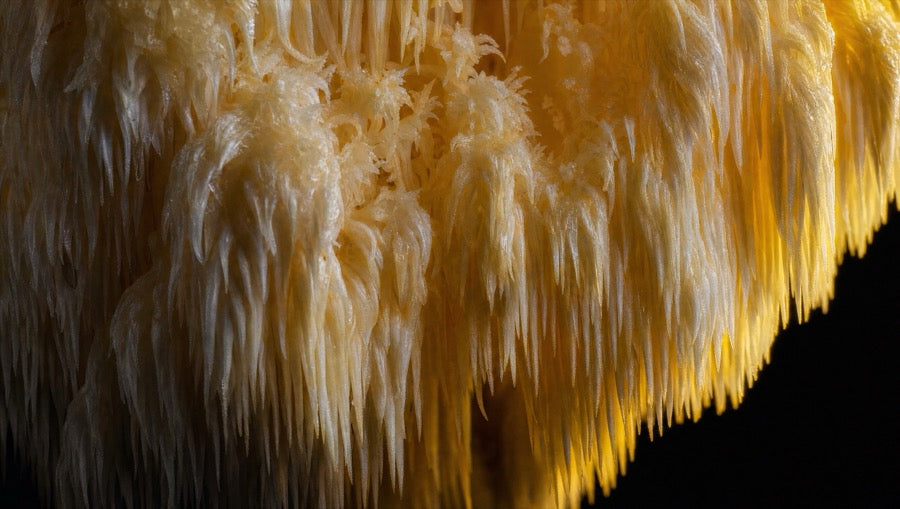
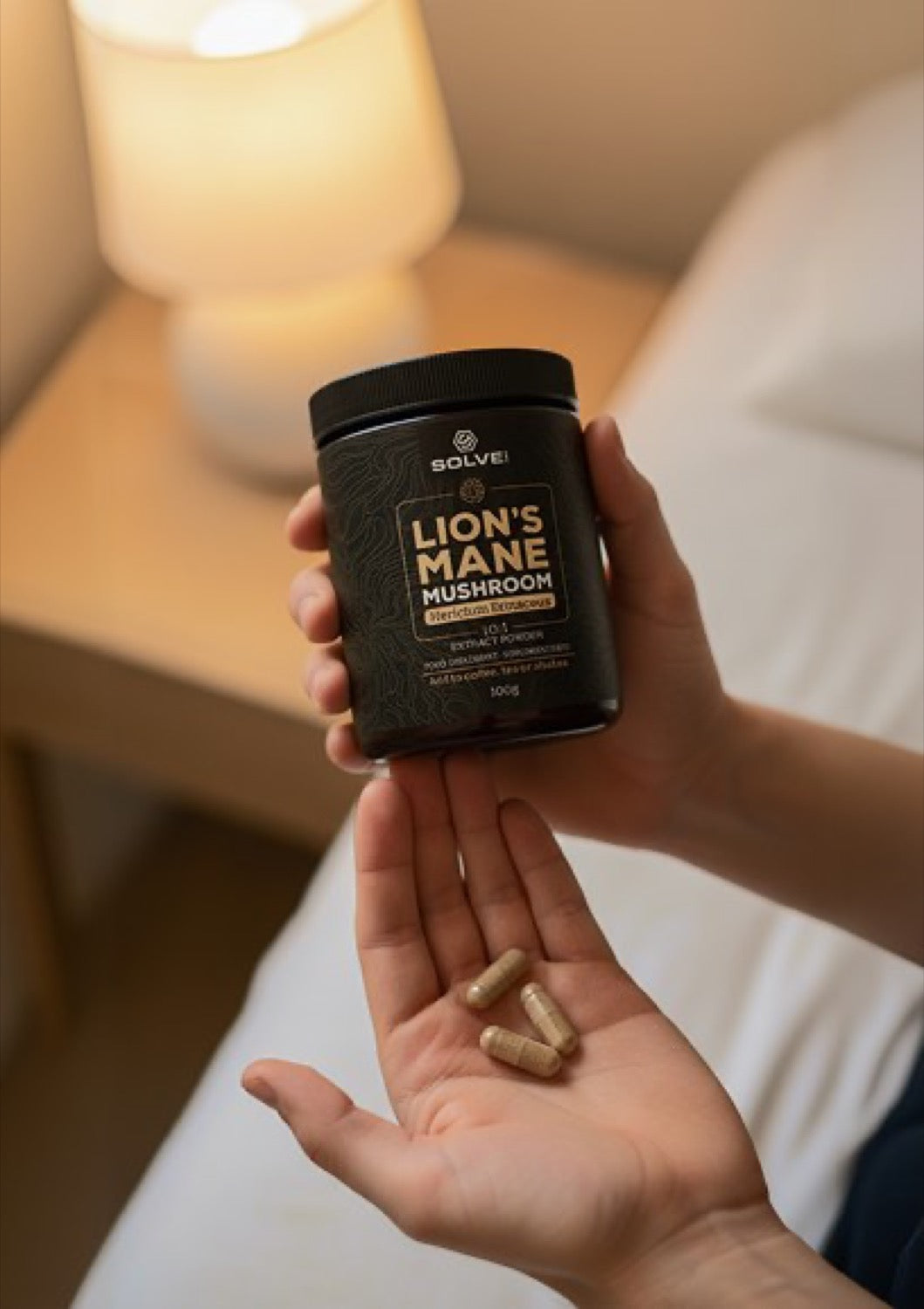
Lion's Mane
Hericium erinaceus (Bull.; Fr.) Pers.
The spined hardwood mushroom
- Beta-D-glucans
- Hericenones
- Polysaccharides
- Dietary fibre
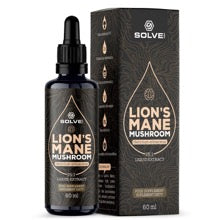
Lion's Mane is an edible fungus that grows as a cascade of soft white spines on hardwood, with no cap and no stem. Its fruiting body carries hericenones, and its polysaccharide fraction is dominated by beta-D-glucans. Ours is fruiting body only, dual extracted in hot water and then alcohol.
Hericenones occur in the fruiting body; the related erinacines occur in mycelium — so which part is used changes the chemistry, not just the label. Dual extraction recovers both the water-soluble polysaccharides and the alcohol-soluble compounds, and our assay reads 33.9% beta-D-glucans on a dry basis.
- Form
- Fruiting body
- Extract ratio
- 10:1 dual extract
- In the drops
- 15:1
- Assay
- 33.9% beta-D-glucans (dry basis)
A controlled human trial, plus a more recent study in healthy adults.

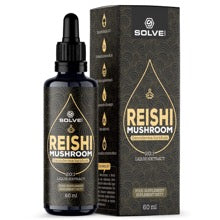
Reishi
Ganoderma lucidum (Curtis) P. Karst.
Lingzhi, the lacquered bracket
- Beta-D-glucans
- Triterpenes (ganoderic acids)
- Peptidoglycans
- Sterols
Reishi is a lacquered, red-brown bracket fungus that grows on dying hardwood, known in Chinese medicine as lingzhi. It carries two distinct fractions — water-soluble beta-D-glucans, and alcohol-soluble triterpenes called ganoderic acids, which give it its bitterness. Ours is fruiting body, dual extracted at 10:1.
One solvent cannot recover both: hot water leaves the triterpenes behind, alcohol leaves the polysaccharides. Dual extraction puts both in the same powder, and the bitterness is how you can taste that it worked. Our batch assay reads 44.3% beta-D-glucans.
- Form
- Fruiting body
- Extract ratio
- 10:1 dual extract
- In the drops
- 20:1
- Assay
- 44.3% beta-D-glucans
A pooled review of the clinical literature.

Chaga
Inonotus obliquus (Ach. ex Pers.) Pilát
The birch sclerotium
- Beta-D-glucans
- Melanin
- Betulinic acid derivatives
- Polyphenols
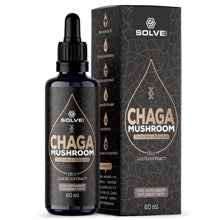
Chaga is not a conventional mushroom but a sclerotium — a dense, charcoal-black mass that forms on living birch over years and cracks open to a golden-ochre interior. It carries beta-D-glucans, melanin and polyphenols. Ours is dual extracted at 10:1.
The black crust is melanin, and chaga is one of very few dietary sources of it. Its betulinic acid derivatives are drawn from the birch itself, so the host tree forms part of the composition. Chaga is also naturally high in oxalate, which is why our serving is stated plainly below.
- Form
- Sclerotium
- Extract ratio
- 10:1 dual extract
- In the drops
- 15:1
- Assay
- 10% beta-D-glucans
Chaga is naturally high in oxalates. Our serving is 1.5 g a day. The single published case of kidney injury involved 10–15 g a day of raw chaga powder for three months — roughly seven to ten times our serving. If you have had calcium oxalate kidney stones or reduced kidney function, speak to your doctor first.

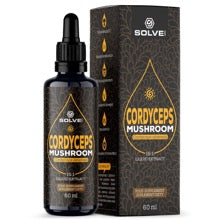
Cordyceps
Cordyceps sinensis (Berk.)
The Himalayan club fungus
- Beta-D-glucans
- Cordycepin
- Adenosine
- Mannitol
Cordyceps is a fungus of the Himalayan plateau whose analytical markers are cordycepin and adenosine, alongside mannitol and beta-D-glucans. The wild fruiting body cannot be cultivated at scale, so almost all commercial cordyceps — and almost all of the human research — uses a cultivated preparation.
Most controlled human work used Cs-4, a fermentation product of C. sinensis. That is why the species and the preparation are named on the product rather than blurred: a trial on Cs-4 does not describe a militaris fruiting body. Ours is assayed at 30% beta-D-glucans.
- Form
- Cultivated preparation — stated on each product
- Extract ratio
- 10:1 extract
- In the drops
- 15:1
- Assay
- 30% beta-D-glucans
A controlled trial in the same species we use.

Tremella
Tremella fuciformis
Snow fungus
- Galactomannan polysaccharide
- Exceptional water-binding capacity
- Dietary fibre
Tremella is a translucent, frilled fungus long used in Chinese kitchens and in skincare, where it is known as snow fungus. Its defining compound is galactomannan, a polysaccharide with an exceptional capacity to bind water. Ours is fruiting body, dual extracted at 10:1.
Galactomannan is a mannose backbone with galactose branches, and that branching gives it both its water-binding and its viscosity in solution — the property that gets tremella compared to hyaluronic acid. Where our other mushrooms are characterised by beta-glucans, this one is characterised by that.
- Form
- Fruiting body
- Extract ratio
- 10:1 dual extract

Maitake
Grifola frondosa
Hen of the woods
- Beta-D-glucans
- Ergosterol
- Dietary fibre
Maitake grows in overlapping grey-brown fans at the base of oaks, and was a prized culinary mushroom in Japan long before anyone thought to extract it. It carries beta-D-glucans with an unusually branched structure, plus ergosterol. Ours is fruiting body, dual extracted at 10:1.
The branched glucan the literature calls grifolan is particular to this species. Its ergosterol is the same fungal sterol that UV light converts into vitamin D2 — the reaction we use deliberately in our shiitake extract, and a reminder that these mushrooms share a chemistry worth understanding.
- Form
- Fruiting body
- Extract ratio
- 10:1 dual extract

Auricularia
Auricularia auricula-judae
Wood ear, the black fungus
- Polysaccharides
- Soluble dietary fibre
- Naturally iron-bearing
Auricularia is the wood ear — dark brown, ear-shaped, translucent and gelatinous when fresh, and the black fungus of Chinese cooking. Unusually for a mushroom extract, much of its polysaccharide fraction is soluble dietary fibre. Ours is fruiting body, dual extracted at 10:1.
That fibre fraction is what gives the fresh fungus its snap, and the reason wood ear behaves differently in water from anything else in the range. It is also among the more mineral-dense edible fungi, iron in particular. Ours is a single-species powder rather than a blend.
- Form
- Fruiting body
- Extract ratio
- 10:1 dual extract

Shiitake
Lentinula edodes (Berk.) Pegler
The UV-exposed vitamin D mushroom
- Vitamin D2 (ergocalciferol)
- Lentinan, a beta-glucan
- Eritadenine
- Ergosterol
Shiitake is a cultivated hardwood mushroom and the best plant source of vitamin D there is. Exposing the fruiting bodies to UV light converts their ergosterol into ergocalciferol — vitamin D2. Ours is standardised to 0.025% of it, delivering 2000 IU.
It is the same photochemistry that happens in human skin, run on a mushroom: UV-B light opens the B-ring of a sterol. In us that sterol is 7-dehydrocholesterol and the product is D3; in fungi it is ergosterol and the product is D2. Vitamin D3 is almost always from lanolin. This is not.
- Form
- Fruiting body
- Standardised to
- 0.025% ergocalciferol (vitamin D2)

Ashwagandha
Withania somnifera (L.) Dunal
The Ayurvedic nightshade root
- Withanolides
- Withaferin A
- Alkaloids
Ashwagandha is a nightshade shrub of dry India whose root is standardised for withanolides — the steroidal lactones that every serious trial measures, withaferin A chief among them. Ours is a root extract at 5% withanolides.
Raw root powder and a 5% withanolide extract can differ by an order of magnitude in that fraction while reading identically on an ingredient list, which is why the percentage matters more than the milligram weight beside it. The trials below were run on standardised extracts, which is what ours is.
- Form
- Root extract
- Standardised to
- 5% withanolides
Among the better-evidenced botanicals we use, with the cortisol finding replicated across independent trials.

Rhodiola
Rhodiola rosea L.
The arctic-alpine root
- Rosavins
- Salidrosides
- Tyrosol
Rhodiola rosea is an arctic-alpine plant of cold, thin, high places, standardised for two markers rather than one. Ours carries 3% rosavins and 1% salidrosides — the same double specification that defines SHR-5, the preparation behind most of the good rhodiola research.
Rosavins occur in R. rosea and are used to authenticate it; salidroside occurs far more widely. Standardising on both is how you demonstrate you hold the species the literature studied rather than a cheaper substitute — which is why the trials below apply to material like ours.
- Form
- Root extract
- Standardised to
- 3% rosavins, 1% salidrosides
Unusually well matched to our material, because the standardisation is the same.

L-theanine
from Camellia sinensis
The amino acid in tea
- An amino acid found almost only in tea
- Structurally close to glutamate
- Occurs alongside caffeine in the same leaf
L-Theanine is a naturally occurring amino acid found almost only in tea leaves. Ours is a green tea extract standardised to 98% L-theanine, and it is the most extensively trialled single ingredient in our range — 31 randomised controlled trials pooled in one meta-analysis.
It is structurally close to glutamate, which is how it crosses the blood-brain barrier, and it is the compound behind the savoury umami note in good green tea. It occurs alongside caffeine naturally in the same leaf, which is why the pairing — not the isolate — is where most of the research sits.
- Form
- Green tea leaf extract
- Standardised to
- 98% L-theanine
The best-evidenced single ingredient in our entire range, by a wide margin.

Bacopa
Bacopa monnieri
Brahmi, the marsh herb
- Bacosides A and B
- Triterpenoid saponins
Bacopa monnieri is a creeping marsh herb of India, known in Ayurveda as brahmi and standardised for its bacosides — a group of triterpenoid saponins, of which bacosides A and B are the two usually quantified.
Saponins of this kind are not fast-acting, and the trial literature reflects it: studies dose over eight to twelve weeks rather than hours. That matches its traditional use as a long course, and it is why bacopa sits in Brain Tech, a formula meant to be taken daily.
- Form
- Whole plant extract

Gotu kola
Centella asiatica
Centella, the wetland green
- Triterpenoid saponins
- Asiaticoside
- Madecassoside
Gotu kola is a low, fan-leafed wetland plant used in both Ayurvedic and Chinese traditions, and eaten as an everyday green in parts of Sri Lanka. Its characteristic compounds are the triterpenoid saponins asiaticoside and madecassoside.
Both are named after the plant itself, Centella asiatica, and both are among the better-characterised plant triterpenes — which is why gotu kola turns up in topical skincare as often as in supplements. Ours sits in Brain Tech beside the bacopa, both long-course botanicals rather than acute ones.
- Form
- Leaf extract

Ginseng
Panax sp.
The Panax tonic root
- Ginsenosides
- Polysaccharides
Ginseng is the classic tonic root of east Asia, standardised for its ginsenosides — a class of more than a hundred related saponins. The word covers several species with genuinely different chemistry, so which one a product uses is not a detail.
Panax ginseng and Panax quinquefolius are not interchangeable, and Siberian 'ginseng' is not a Panax at all; processing shifts the ginsenoside ratio again. That is why the literature is harder to pool than it looks, and why ours names the species on the label.
- Form
- Root extract

Astragalus
Astragalus membranaceus Moench
Huang qi, the sliced root
- Astragalosides
- Polysaccharides
- Flavonoids
Astragalus is a legume root long used in Chinese medicine, sliced to show a pale radial grain. It carries astragalosides — cycloartane triterpene glycosides — alongside a polysaccharide fraction and flavonoids.
Astragaloside IV is the marker analytical work usually quantifies, and it is present at low percentages even in good material — which is why an extract ratio is worth stating where a raw weight is not. Ours is a 10:1 root extract in Shroom Force.
- Form
- Dried root extract

Grape seed
Vitis vinifera L.
The winemaking by-product
- Oligomeric proanthocyanidins (OPCs)
- Polyphenols
- Catechins
Grape seed extract is pressed from wine-grape seeds and standardised for oligomeric proanthocyanidins — OPCs, chains of catechin units. It is among the more concentrated polyphenol sources available.
Chain length is the specification that matters: the shorter oligomers are the ones absorption studies concentrate on, so a total proanthocyanidin figure tells you less than the oligomeric fraction does. Ours is a seed extract in Shroom Force rather than a whole-fruit powder, because the seed is where the OPCs are.
- Form
- Seed extract

Saffron
Crocus sativus
The world's costliest spice
- Crocin
- Safranal
- Picrocrocin
Saffron is the dried stigma of Crocus sativus, and the most expensive spice on earth by weight — roughly 150,000 hand-picked flowers per kilogram. Its three signature compounds each do a different job: crocin the colour, picrocrocin the bitterness, safranal the aroma.
Crocin doubles as the quality marker, because ISO 3632 grades saffron by its colouring strength — which matters in a spice this widely adulterated. Ours is in the Calm Reishi Gummies at extract level, which at saffron's price is rarer than it should be.
- Form
- Stigmas

Valerian
Valeriana officinalis
The evening root
- Valerenic acid
- Sesquiterpenes
- Volatile oil
Valerian is a tall flowering plant whose root has a long European history as an evening herb, and an unmistakable smell. It is standardised for valerenic acid, alongside a group of sesquiterpenes in its volatile oil.
Valerenic acid is unstable, so how the root is dried and stored changes the finished material more than it does with most botanicals — the smell is the volatile oil escaping. Ours goes into the Mushroom Cacao, an evening drink, which is the only place in the range it belongs.
- Form
- Root

Maca
Lepidium meyenii
The Andean root vegetable
- Macamides
- Glucosinolates
- Plant sterols
Maca is a cruciferous root vegetable grown above 4,000 metres in the Peruvian Andes, where it is eaten as a food rather than taken as a supplement. It carries macamides — benzylalkylamides found in essentially nothing else — plus glucosinolates and plant sterols.
Because it is a food crop, traditional intake is measured in grams of root, not milligrams of extract. That is the whole reason a concentrate exists: ours is 4:1, in the Mushroom Matcha, which is how a meaningful fraction of a culinary dose fits into a drink.
- Form
- Root extract 4:1
- Extract ratio
- 4:1

Matcha
Camellia sinensis
Shade-grown, stone-ground tea
- L-theanine
- Catechins (EGCG)
- Naturally occurring caffeine
- Chlorophyll
Matcha is shade-grown Japanese green tea, stone-ground so the whole leaf is consumed rather than infused and discarded. It carries L-theanine, catechins and caffeine together in the same leaf. Ours is organic, used at 22%.
Shading the plants before harvest raises the leaf's L-theanine and chlorophyll, which is why matcha is greener and less astringent than sencha. Consuming the whole leaf is also what delivers the catechin fraction — EGCG chief among it — that a steeped leaf leaves behind.
- Form
- Stone-ground whole leaf
- Specification
- Organic, 22% of the blend

Coffee
Coffea arabica
Brazilian speciality arabica
- Chlorogenic acids
- Naturally occurring caffeine
Our coffee is a single-origin Brazilian speciality arabica, medium roast — cocoa, chocolate, nut, caramel and red fruit. Its largest polyphenol fraction is chlorogenic acids, alongside naturally occurring caffeine.
Roast level is the main thing that determines how much of that fraction survives, because darker roasts degrade it — a medium roast is the compromise between the chemistry and the cup. Both our coffees are mycotoxin tested by an accredited lab, because ochratoxin A is a real risk in poorly stored green coffee.
- Form
- Roasted bean
- Specification
- Brazilian speciality grade, medium roast

Cacao
Theobroma cacao
The unalkalised bean
- Flavanols
- Theobromine
- Naturally magnesium-dense
Cacao is the seed of Theobroma cacao, used here as nibs rather than processed chocolate liquor. It carries flavanols, theobromine — a methylxanthine related to caffeine but slower and milder — and is naturally magnesium-dense.
Alkalisation destroys the flavanol fraction: Dutch-process cocoa can lose most of it, which is why the processing method tells you more than the cocoa percentage does. Ours is unalkalised nib in the Mushroom Cacao.
- Form
- Bean

Yerba mate
Ilex paraguariensis
The shared gourd leaf
- Xanthines (caffeine and theobromine)
- Chlorogenic acids
- Saponins
Yerba mate is a South American holly whose leaves are dried, ground and traditionally shared from a gourd. It delivers a xanthine profile rather than a single stimulant — caffeine with theobromine — plus chlorogenic acids and saponins.
Those saponins give mate both its foam and its bitterness, and are what most distinguishes it chemically from tea. Ours is a whole-leaf mushroom yerba mate, rather than isolated caffeine added to something else.
- Form
- Leaf

Acerola
Malpighia emarginata
The vitamin C cherry
- One of the richest natural sources of vitamin C
- Anthocyanins
- Carotenoids
Acerola is a West Indian cherry carrying one of the highest natural vitamin C contents of any fruit — 1,500 to 2,000 mg per 100 g, roughly thirty times an orange. It comes with the anthocyanins and carotenoids of the whole fruit.
That concentration is what makes a fruit-source vitamin C practical at all: most fruits are simply too dilute to build a supplement on without concentrating them past the point of being fruit. It is why our vitamin C is acerola-derived rather than synthetic ascorbic acid.
- Form
- Fruit extract
- Specification
- Vitamin C source

Hibiscus
Hibiscus sp.
The roselle calyx
- Anthocyanins
- Organic acids
- Polyphenols
Hibiscus is the dried calyx of the roselle flower — deep magenta, sharply tart, carrying anthocyanins and organic acids including citric and hibiscus acid.
Both the colour and the tartness are pH-dependent, which is why a hibiscus infusion shifts from red toward purple as acidity changes: the same molecule, behaving differently. Ours is in the Electrolytes, doing the flavour work instead of an artificial acidulant.
- Form
- Flower extract

Rowan berry
Sorbus aucuparia
The alcohol-free preservative
- Organic acids, including sorbic acid
Rowan berry is the fruit of the mountain ash, naturally high in organic acids — sorbic acid among them, which was first isolated from this berry and takes its name from it. It is the natural preservative in our drops.
Lowering pH is one of the oldest ways to keep a water-based extract stable, and it is what makes an alcohol-free tincture possible at all. It is the reason every one of our drops is alcohol-free.
- Form
- Fruit extract

Guarana
Paullinia cupana
The Amazonian seed
- Naturally occurring caffeine
- Tannins
- Saponins
Guarana is an Amazonian climbing plant whose seed carries more caffeine by weight than a coffee bean, bound up with tannins, alongside theobromine and saponins.
That tannin binding is the usual explanation for why guarana releases more slowly than an equivalent dose of isolated caffeine — like mate, it delivers a xanthine profile rather than a single compound. Ours is whole seed in Brain Tech, beside the L-theanine rather than on its own.
- Form
- Seed

Vitamin D2
Ergocalciferol
Ergocalciferol, from mushrooms
- Ergocalciferol, the vegan form of vitamin D
- Contributes to the normal function of the immune system
- Contributes to the maintenance of normal bones
Vitamin D2 — ergocalciferol — is the form mushrooms produce when UV light reaches them, and the only genuinely vegan route to vitamin D at scale. Ours comes from shiitake standardised to 0.025%, delivering 2000 IU.
The UK actively advises supplementing vitamin D between October and March, because at British latitudes the sun sits too low for skin synthesis for roughly half the year. Vitamin D carries authorised claims on the GB register, so this is one of the few entries where we may state an effect — those claims are above.
- Form
- From UV-exposed shiitake
- Specification
- 2000 IU per capsule

Vitamin C
Ascorbic acid, from acerola
Ascorbic acid, from acerola
- Ascorbic acid, from acerola
- Contributes to normal collagen formation
- Contributes to the reduction of tiredness and fatigue
- Contributes to normal energy-yielding metabolism
Vitamin C is an essential nutrient humans cannot synthesise. Ours comes from acerola cherry as a whole fruit extract rather than as synthesised ascorbic acid, and it is the nutrient we pair with the collagen.
We lost the last enzyme in the pathway, L-gulonolactone oxidase, to a gene deletion in our primate ancestry — which is why vitamin C is a dietary requirement for us and not for a dog. It is water-soluble and barely stored, so intake matters continuously. Its authorised claims are above.
- Form
- Fruit extract

Magnesium
Magnesium citrate
Magnesium citrate
- Magnesium citrate
- Contributes to normal muscle function
- Contributes to normal functioning of the nervous system
- Contributes to the reduction of tiredness and fatigue
Magnesium is an essential mineral, present here as magnesium citrate — an organic acid salt chosen because it dissolves. Magnesium oxide is cheaper and carries more elemental magnesium per gram, but is poorly soluble and much less well absorbed.
Absorption depends heavily on the counter-ion the magnesium arrives with, and comparative studies consistently place citrate above the oxide — which is why the form on the label tells you more than the milligram figure beside it. Its authorised claims are above.
- Form
- Mineral salt

Zinc
Zinc
The trace mineral cofactor
- Zinc
- Contributes to the maintenance of normal hair, skin and nails
- Contributes to the normal function of the immune system
Zinc is an essential trace mineral and a cofactor in hundreds of human enzymes. Ours is in the Shilajit Complex, at a sensible daily level rather than a headline one.
There is no meaningful storage pool for zinc, so intake is a continuous matter rather than something you can load. It also competes with copper for absorption, which is why an indefinite high dose is not a neutral act and the level matters. Its authorised claims are above.
- Form
- Mineral

B vitamins
Thiamine, riboflavin, niacin, B6, B12, folate, biotin, pantothenic acid
The methylated B group
- Methylcobalamin (B12)
- Pyridoxal-5-phosphate (B6)
- Calcium L-methylfolate
- Thiamine, riboflavin, niacin, pantothenic acid, biotin
- Contribute to the reduction of tiredness and fatigue
Our B-complex is built on the active, methylated forms rather than the cheapest available: methylcobalamin instead of cyanocobalamin, pyridoxal-5-phosphate instead of pyridoxine, calcium L-methylfolate instead of folic acid.
The cheaper forms must be converted inside the body before use, and a substantial minority of people carry MTHFR variants that make the folate conversion measurably less efficient. Supplying the methylated form skips the step. It costs more, and it is the reason this formula exists.
- Form
- Vitamin blend
- Specification
- Methylated and active forms: pyridoxal-5-phosphate, methylcobalamin, calcium L-methylfolate

Electrolyte salts
Sodium, potassium, calcium
The four sweat minerals
- Sodium, potassium, calcium and magnesium
- Citrate and chloride salts
- Calcium contributes to normal muscle function
Electrolytes are the minerals lost in sweat — sodium, potassium, calcium and magnesium — supplied here as citrate and chloride salts, in the forms that dissolve.
Rehydration is not simply water: sodium is what allows water to be retained rather than passed straight through, which is the principle behind every oral rehydration solution. Citrate salts sit beside the chlorides because they are gentler on the stomach at drinkable concentrations.
- Form
- Mineral salts
- Specification
- Calcium lactate, magnesium citrate, potassium citrate, potassium chloride, sodium chloride, sodium citrate

Creatine
Creatine monohydrate
Micronised monohydrate
- Creatine monohydrate
- Increases physical performance in successive bursts of short-term, high-intensity exercise
Creatine monohydrate is the most studied sports supplement in existence, and the only form with a substantial evidence base behind it. Ours is micronised, single-ingredient, and it carries an authorised claim we meet the conditions for.
Creatine buffers ATP regeneration during short, maximal efforts, which is why the research clusters around repeated high-intensity work rather than endurance. Roughly half of what the body uses is made internally, the rest from diet — which is why vegetarians typically start from lower muscle stores.
- Form
- Powder

Collagen peptides
Hydrolysed bovine collagen, types I and III
Hydrolysed peptides, I and III
- Hydrolysed peptides, types I and III
- Low molecular weight
- Glycine-rich
Collagen peptides are hydrolysed — enzymatically cut into short chains — because intact collagen is far too large to absorb. Ours are types I and III at a low molecular weight, and they arrive with vitamin C in the same formula.
Molecular weight is the specification that matters, not the gram figure. Types I and III are the collagens of skin, bone and connective tissue, as distinct from type II, which is cartilage. Vitamin C is a required cofactor for the enzymes that hydroxylate proline during collagen synthesis — which is why the authorised claim exists, and why the two ship together.
- Form
- COLLinstant® hydrolysed peptides
- Specification
- With hyaluronic acid

Hyaluronic acid
Sodium hyaluronate
The water-binding molecule
- Hyaluronic acid
- Exceptional water-binding capacity
Hyaluronic acid is a glycosaminoglycan that occurs naturally throughout the body, in highest concentration in skin and synovial fluid. A single gram can hold several litres of water. Ours sits alongside the collagen.
That water-binding is what makes it structurally useful in tissue rather than merely wetting. Molecular weight again governs behaviour — high and low molecular weight HA are not interchangeable materials, and the distinction is rarely stated on a label.
- Form
- Powder

Shilajit
Fulvic acid complex
The mountain resin
- Fulvic acid
- Humic substances
- Trace minerals
Shilajit is a tarry exudate that seeps from rock in high mountain ranges, formed over centuries from compressed plant matter. Its functional fraction is fulvic acid, a low-molecular-weight humic substance, alongside a broad profile of trace minerals.
Fulvic acid acts as a natural chelator — it binds metal ions — which is precisely why purity is not a side issue with this ingredient but the whole issue: unpurified shilajit can carry heavy metals. Ours is laboratory tested and the report is published.
- Form
- Purified resin
- Specification
- Purity tested in an accredited laboratory

Beta-D-glucans
—
The assayed mushroom active
- The polysaccharide the mushroom literature concentrates on
- Beta-linked, as distinct from the alpha-glucans in starch
- Measured by assay, not estimated
Beta-D-glucans are the polysaccharide fraction that mushroom research concentrates on, and the fraction we assay in every mushroom we make. They are beta-linked, as distinct from the alpha-glucans that make up starch.
That distinction is what separates a real extract from ground grain. Mycelium grown on a grain substrate is harvested with the substrate attached, so the powder carries starch — and a total 'polysaccharide' figure counts it while a beta-D-glucan assay does not. It is why we publish the beta figure specifically.
- Form
- Assayed fraction
- Specification
- Lion's Mane 33.9% (dry)
- Specification
- Reishi 44.3%
- Specification
- Cordyceps 30%
- Specification
- Chaga 10%

Caffeine
—
Never isolated, always in a plant
- Naturally occurring, from matcha, coffee, guarana and mate
- An adenosine receptor antagonist
Caffeine is a naturally occurring stimulant and the most widely consumed psychoactive compound on earth, found in coffee, tea, guarana and mate. Every bit of it in our range arrives inside one of those plants.
It works as an adenosine receptor antagonist. Arriving with the plant matters chemically as well as philosophically: in tea it comes with L-theanine, in guarana bound to tannins, in mate with theobromine — and each changes the profile relative to an isolated dose in a capsule.
- Form
- Naturally occurring

Galactomannan
—
Tremella's polysaccharide
- A mannose backbone with galactose branches
- High water-binding capacity
Galactomannan is the polysaccharide that gives Tremella its character: a mannose backbone with galactose branches, and an exceptional capacity to bind water.
The branching is what produces both the water-binding and the viscosity in solution. It belongs to the same broad class of molecule as guar and locust bean gum, which is why Tremella thickens water the way it does. It is why our Tremella stands as a single species rather than being blended away.
- Form
- Polysaccharide

Inulin
from chicory root
Chicory prebiotic fibre
- A fructan — a chain of fructose units
- Soluble prebiotic fibre
Inulin is a fructan — a chain of fructose units that human digestive enzymes cannot break. Ours is chicory inulin, used as the capsule filler, so the bulking agent is itself a soluble prebiotic fibre.
Because it passes intact to the colon, where gut bacteria ferment it, it is a prebiotic rather than a probiotic: the fibre, not the organism. That fermentation is also why a large dose taken suddenly is uncomfortable — the effect is real, not imagined.
- Form
- Prebiotic fibre

Choline
Choline bitartrate
The membrane precursor
- Choline bitartrate
- Precursor to phosphatidylcholine and acetylcholine
- Contributes to normal lipid metabolism
Choline is an essential nutrient, present here as choline bitartrate. It is the precursor to phosphatidylcholine, a major structural component of every cell membrane, and to acetylcholine.
The body makes some but not enough, which is why it was formally classified as essential only in 1998 — recent, for a nutrient — and why most people under-consume it. The bitartrate salt is used for stability, because choline itself is strongly hygroscopic.
- Form
- Nutrient

Inositol
—
The cyclic sugar alcohol
- A cyclic sugar alcohol
- Backbone of the phosphoinositide signalling system
Inositol is a cyclic six-carbon sugar alcohol, historically called vitamin B8 though it is not strictly a vitamin. Ours sits in the Complete B-Complex alongside the choline.
It forms the backbone of the phosphoinositide second-messenger system, which cells use to relay signals inward from their surface. It lost vitamin status because the body synthesises it from glucose, so it is not strictly a dietary requirement.
- Form
- Nutrient

DigeZyme®
Multi-enzyme complex
A branded enzyme complex
- Amylase, protease, lipase, cellulase, lactase
- Activity measured in units, not milligrams
DigeZyme® is a branded multi-enzyme complex rather than a single enzyme, covering the four macronutrient classes plus lactose: amylase, protease, lipase, cellulase and lactase.
Each enzyme has one substrate, which is why a blend is used instead of one enzyme — and why activity is measured in units rather than milligrams, since what matters is what the enzyme can do, not what it weighs. Ours is in the plant protein, where it has actual work to do.
- Form
- Enzyme blend

Plant protein blend
Pea, yeast, rice, pumpkin
Four complementary proteins
- Pea, rice, pumpkin and yeast protein
- Complementary amino acid profiles
Our protein is a blend of four plants — pea, rice, pumpkin and yeast — because no single plant protein carries a complete amino acid profile on its own.
Pea protein is low in methionine and rice protein is low in lysine, and each is strong precisely where the other is weak, so blending them produces a profile closer to complete than either reaches alone. It is the principle behind rice and beans, applied as a formulation decision. Ours needs no added amino spike to look complete on paper.
- Form
- Protein blend

Greens blend
Chlorella, spirulina, barley grass
Algae and cereal grass
- Chlorella and spirulina
- Barley and wheat grass
- Chlorophyll
Our greens are three with real substance behind them rather than a long list in trace amounts: chlorella, spirulina, and barley and wheat grass. The deep colour is chlorophyll.
Chlorella and spirulina are not the same kind of organism: spirulina is a cyanobacterium, while chlorella is a true single-celled green alga with a tough cellulose wall that must be mechanically broken before its contents are available. That is why 'cracked cell wall' is a real specification and not a marketing phrase.
- Form
- Whole-food powders

GABA
Gamma-aminobutyric acid
The inhibitory neurotransmitter
- Gamma-aminobutyric acid
- The principal inhibitory neurotransmitter
GABA — gamma-aminobutyric acid — is an amino acid the body produces itself, and the principal inhibitory neurotransmitter of the mammalian central nervous system. Ours is in the Calm Reishi Gummies.
It is the counterpart to glutamate, which is excitatory. Taken orally it is poorly permeable across the blood-brain barrier, which is why the interesting research concerns the enteric nervous system rather than direct central action. Ours sits in an evening formula rather than anywhere in the daytime range.
- Form
- Free amino acid
- Specification
- 100 mg per serving

Betaine (TMG)
Trimethylglycine
Trimethylglycine, from beet
- Trimethylglycine
- A methyl donor
Betaine — trimethylglycine — was first isolated from sugar beet, which is where the name comes from. It is a methyl donor, and it appears twice in our range: in the Complete B-Complex and in Creatine+.
It carries methyl groups through the same one-carbon metabolism that the methylated B vitamins feed, converting homocysteine back to methionine. That is exactly why it sits in the same capsule as methylcobalamin and L-methylfolate rather than on its own — three ingredients on one pathway.
- Form
- Trimethylglycine
- Specification
- In the B-complex and in Creatine+

PABA
Para-aminobenzoic acid
Once called vitamin B10
- Para-aminobenzoic acid
- Historically grouped with the B vitamins
PABA — para-aminobenzoic acid — was historically counted among the B vitamins and is sometimes still called vitamin B10. Ours is in the Complete B-Complex, beside the choline, inositol and betaine.
It is a precursor in folate synthesis — but in bacteria and plants, not in humans, who cannot build folate and must take it from the diet. That is why it is no longer classed as a vitamin for people: the pathway it belongs to is not ours.
- Form
- Para-aminobenzoic acid
- Specification
- In the Complete B-Complex

Probiotic culture
Live bacterial culture
A live culture
- A live bacterial culture
- Formulated alongside a digestive enzyme complex
A probiotic is a live bacterial culture. Ours is in the Complete Green Superfoods, formulated alongside the DigeZyme® enzyme complex rather than on its own.
A probiotic and a prebiotic are not the same thing: the probiotic is the organism, the prebiotic is the fibre it ferments — which is why our range carries inulin as well. Ours is paired with the enzyme complex because the two act on the same part of digestion.
- Form
- Live culture
- Specification
- In Complete Green Superfoods

Coenzyme Q10
Ubiquinone
Ubiquinone
- Ubiquinone
- Carries electrons in the mitochondrial transport chain
Coenzyme Q10 — ubiquinone — is a compound the body makes itself, present in every cell that uses oxygen. It is a component of the mitochondrial electron transport chain. Ours appears in the Complete B-Complex and the Complete Green Superfoods.
It shuttles electrons between complexes in the mitochondrial membrane, at the final stage of aerobic energy metabolism. Endogenous production declines with age, which is why it is among the more commonly supplemented compounds despite not being a vitamin. Ours sits with the B vitamins because they act on the same pathway.
- Form
- Ubiquinone
- Specification
- In the B-complex and the greens blend

L-leucine
Branched-chain amino acid
A branched-chain amino acid
- A branched-chain amino acid
- One of the nine essential amino acids
L-leucine is one of the three branched-chain amino acids and one of the nine the body cannot synthesise. Ours is in the Complete B-Complex.
Leucine has the most distinct role of the three: unlike most amino acids it acts as a signalling molecule as well as a building block, which is why it is studied separately rather than as part of a BCAA trio.
- Form
- Free amino acid
- Specification
- In the Complete B-Complex

Glycine
Aminoacetic acid
The simplest amino acid
- The simplest amino acid
- The most abundant residue in collagen
Glycine is the smallest of the amino acids — a single hydrogen where every other one carries a side chain — and the most abundant residue in collagen. Ours is in the Shilajit Complex and in Creatine+.
It is one of three amino acids the body uses to build its own creatine, with arginine and methionine, which is precisely why it appears in Creatine+ rather than as an afterthought. In collagen it accounts for roughly a third of the protein by residue count.
- Form
- Free amino acid
- Specification
- In Shilajit Complex and Creatine+

L-arginine
Conditionally essential amino acid
A conditionally essential amino acid
- A conditionally essential amino acid
- Substrate for nitric oxide synthase
L-arginine is conditionally essential — one the body can normally make, but not always fast enough. Ours is in Creatine+.
It is the second of the three amino acids in endogenous creatine synthesis, alongside glycine and methionine, which is why both it and glycine sit in the same formula as the monohydrate. It is also the substrate for nitric oxide synthase, which is why it recurs in pre-workout formulations.
- Form
- Free amino acid
- Specification
- In Creatine+

Milk thistle
Silybum marianum
The thistle seed
- Silymarin
- A complex of flavonolignans, chiefly silybin
Milk thistle is a spiny purple-flowered thistle of the Mediterranean, grown for its seed and standardised for silymarin — not one compound but a complex of flavonolignans, chiefly silybin.
Silymarin is poorly water-soluble, which is why extract quality varies so widely between products bearing the same name: the standardisation figure, not the plant name, is what tells you what you have. Ours is in the Complete Green Superfoods.
- Form
- Seed extract
- Specification
- In Complete Green Superfoods

Beetroot
Beta vulgaris
The nitrate root
- Dietary nitrate
- Betalain pigments
Beetroot is one of the richest dietary sources of inorganic nitrate, and its deep colour comes from betalain — a pigment class distinct from the anthocyanins in most red plants. Ours is a root powder in the Complete Green Superfoods.
The nitrate pathway only became well understood in the last twenty years: oral bacteria reduce dietary nitrate to nitrite, which the body converts further. That is the reason beetroot is studied in sport at all, and why it is a genuine active rather than only a colourant.
- Form
- Root powder
- Specification
- In Complete Green Superfoods

Ginger
Zingiber officinale
The rhizome, not a root
- Gingerols
- Shogaols, formed when the rhizome is dried
Ginger is botanically a rhizome rather than a root, standardised for its gingerols — the compounds behind its pungency. Ours appears in the Complete Green Superfoods and in the Mushroom Matcha.
Gingerols are unstable in a useful way: drying converts gingerol into shogaol, which is why dried ginger tastes sharper and less bright than fresh. The form used therefore determines the flavour as much as the dose does.
- Form
- Rhizome
- Specification
- In the greens blend and Mushroom Matcha

Cinnamon
Cinnamomum
The bark quill
- Cinnamaldehyde
- Volatile bark oil
Cinnamon is the inner bark of trees of the genus Cinnamomum, rolled into quills as it dries. Its aroma is almost entirely cinnamaldehyde. Ours is in the Mushroom Cacao, part of what makes it drinkable without sugar.
The distinction worth knowing is Ceylon versus cassia: cassia is the cheaper and far more common bark, and it carries substantially more coumarin, for which a tolerable daily intake exists. Which species a product uses is rarely stated, and it matters.
- Form
- Bark
- Specification
- In Mushroom Cacao

Cardamom
Elettaria cardamomum
The green pod
- 1,8-cineole
- Terpinyl acetate
Cardamom is the seed pod of Elettaria cardamomum, and the third most expensive spice by weight after saffron and vanilla. Its character comes from a volatile oil dominated by 1,8-cineole and terpinyl acetate.
That oil is highly fugitive, which is why whole pods hold their aroma and pre-ground cardamom loses it within weeks — the reason good cardamom is bought in the pod. Ours is in the Mushroom Cacao.
- Form
- Seed pod
- Specification
- In Mushroom Cacao

Nutmeg
Myristica fragrans
The marbled seed
- Myristicin
- Volatile seed oil
Nutmeg is the seed kernel of an Indonesian evergreen; mace is the lacy covering around the same seed. It carries myristicin in its volatile oil. Ours is in the Mushroom Matcha, at culinary levels.
Culinary levels is the whole point: myristicin is unpleasant and genuinely toxic in quantity, so a pinch in a drink is food and a spoonful is not. It is an ingredient that belongs nowhere near a high-dose extract.
- Form
- Seed
- Specification
- In Mushroom Matcha

Coconut
Cocos nucifera
The medium-chain fat
- Medium-chain fatty acids, chiefly lauric acid
- Naturally saturated plant fat
Coconut milk powder is unusual among plant fats for being largely saturated and largely medium-chain, lauric acid chief among them. Ours is in the Mushroom Cacao and the Mushroom Matcha, doing the work dairy would otherwise do.
Medium-chain fatty acids have shorter carbon chains than the long-chain fats in most oils, which is why they behave differently in digestion. In a drink powder it is also what carries mouthfeel — the practical reason it is there.
- Form
- Milk powder
- Specification
- In Mushroom Cacao and Matcha